
Work doesn't stand still for long. New software arrives and roles get reshaped, often faster than anyone planned for. The way people work has shifted too. More than a quarter of working adults in Great Britain (28%) were hybrid working in early 2025, according to the Office for National Statistics.
So why is adaptability important, and how do you build more of it when your week is already full? This guide covers why it counts whether you're employed or running your own business, and how flexible online learning can help you keep growing without putting everything else on hold.
Why is adaptability important?
Adaptability is your ability to adjust when things change. That could be a new system at work, a new manager, a quiet month for sales or a complete change of direction. People who adapt well don't necessarily enjoy change. They just tend to recover from it faster and spot the opportunity in it sooner.
Why is adaptability important for almost everyone in work right now? Mostly because skills date faster than they used to. What was enough five years ago might not be enough today, and the gap tends to grow quietly until a restructure or a job application makes it obvious.
There's a confidence side to it as well. Once you've handled one big change, the next one feels less daunting. That makes it easier to say yes when an opportunity comes along, whether it's a promotion at work or the business idea you've been sitting on for a while.
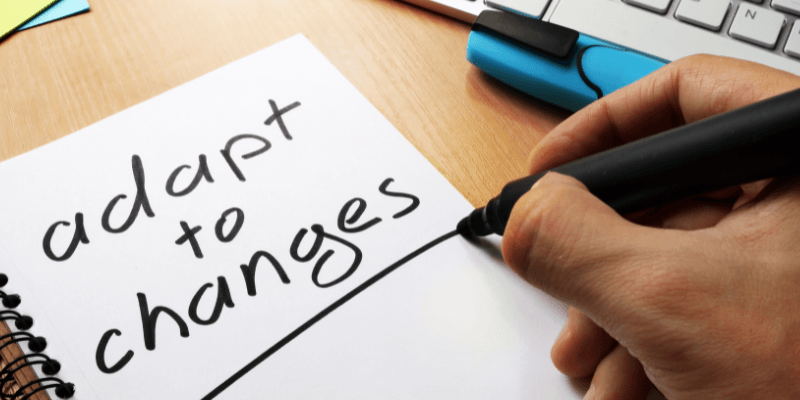
Why is adaptability important in the workplace?
So, why is adaptability important in the workplace in particular? Most jobs now change shape every year or two. New digital tools and AI assistants arrive, and teams get reorganised. The people who cope best are the ones who pick up the new way of doing things without too much fuss and help others do the same.
Employers notice that. When plans change at short notice, managers remember who stepped up and who dug their heels in. It often decides who gets trusted with bigger projects and who's considered for promotion.
There's another reason why adaptability is important in the workplace, and it's a practical one. You can't always rely on your employer to keep your skills up to date. The Department for Education's Employer Skills Survey 2024 found that 59% of UK employers had provided any training for staff in the previous 12 months, down from 66% in 2017. Taking charge of your own learning is a big part of staying adaptable.
If you'd like to see which other qualities employers look for, our guide to the soft skills employers want is a good next read.
Why is adaptability important for entrepreneurs?
When you run your own business, you're often the salesperson and the bookkeeper, and probably the one answering customer emails at 10pm too. There's rarely anyone to pass a problem on to. According to the Department for Business and Trade's business population estimates, there were around 5.7 million private sector businesses in the UK at the start of 2025, and 75% of them didn't employ anyone apart from the owners.
So why is adaptability important for entrepreneurs in particular? Partly because when tax rules change or a bigger competitor opens down the road, it's down to you to work out what happens next. You can't wait for someone else to come up with a plan.
The good news is that small businesses can change direction far more quickly than large ones. You don't need sign-off from a board to try a new product or rethink your pricing. You just need the skills and the confidence to do it well.
Why is adaptability important in business?
Why is adaptability important in business, even for firms that are doing well? Customers' needs shift, sometimes slowly and sometimes overnight. A business that keeps doing what it's always done can lose ground without noticing until the numbers drop. That's why adaptability is important in business of any size, from a sole trader to a growing team.
Being able to adapt your business usually comes down to a few habits:
- Keeping a close eye on your figures, so you spot changes early
- Talking to customers regularly and acting on what they tell you
- Reviewing your plan at least once a year, rather than writing it once and filing it away
- Testing small changes before committing to big ones
- Learning the skills you're missing, rather than avoiding the jobs that need them
If you've never written a proper plan or strategy, a short course can give you a framework to work from. Our Business Planning and Business Strategy (Byte Size Skills Course) courses are good places to start.

How to be adaptable in your career
Learning how to be adaptable in your career is less about personality and more about habits. Anyone can get better at it with a bit of practice.
Start by paying attention to where your role and industry are heading. Look at job adverts for the position you'd like next and note the skills that keep coming up. Ask your manager or colleagues for honest feedback, and say yes to the occasional project that feels slightly beyond you. Each of these gives you a little more experience of handling something new.
It's also worth taking stock of what you already bring. Many of the strengths you've built in one job carry straight over to another, and our guide to transferable skills can help you work out what yours are. Knowing how to be adaptable in your career often starts with realising you're more adaptable than you thought.
How to improve your adaptability skills
If you're wondering how to improve your adaptability skills, the most useful approach is to practise change in small, low-risk ways before a big change forces the issue. Here are some ideas to try:
- Change small routines on purpose. Take a different route, try a new tool or switch up how you plan your week. It trains you to be comfortable with unfamiliar situations.
- Learn something from scratch. Being a beginner again is uncomfortable, and that's the point. It reminds you that you can get from knowing nothing to knowing quite a lot.
- Reflect after each change. Once the dust settles, think about what helped and what you'd do differently. That's how experience turns into a skill.
- Build a network you can lean on. Colleagues and mentors can give you a perspective you wouldn't find on your own.
- Keep learning in a structured way. A course gives you a clear path, deadlines to work towards and a tutor to check your progress.
Our Change Management course is a natural fit here. It's aimed at anyone considering significant change in their life or career, and covers topics such as the changing work environment, managing people through change, handling stress and conflict, and goal setting. For anyone serious about how to improve your adaptability skills, it gives you a practical structure to build on.
How flexible online learning fits a modern working lifestyle
Traditional courses usually ask you to be in a certain place at a certain time. That's hard to manage if you work shifts, juggle childcare, run a business or split your week between home and the office.
Online learning works the other way round. It fits around you. With learndirect, our courses are studied 100% online, so you can learn from your computer or laptop, whenever it suits you. That might be an hour on a Sunday morning or 20 minutes on your lunch break.
Here's how it works in practice:
- Easy to get started. The courses featured here don't ask for any previous experience or qualifications. Entry requirements vary across our wider range, so it's always worth checking the course page before you enrol.
- Study at your own pace. You decide when and where you study, and you can speed up or slow down around busy periods.
Some courses are short enough to finish in a few evenings. Starting Your Own Business, for example, is takes around 60 hours to complete. That makes it realistic to adapt your skills alongside your job or business rather than waiting for a quieter time that might never come.
If you're comparing different ways to study around work, our round-up of part-time distance learning options in the UK is worth a read too.

Courses to help you adapt your skills
We've picked out courses for two groups of learners: people who run their own business (or want to) and people in employment who want to upskill. You'll find more options across our Entrepreneurship Courses and Workplace Skills Courses.
If you run your own business or want to start one
- Starting Your Own Business: takes you through the essentials of setting up, from business plans and SWOT analysis to costing, banking and simple bookkeeping. You'll also look at the tax differences between being a sole trader, a partnership or a limited company, and what's involved in registering a business.
- Small Business Management: ideal if you're thinking of starting a business or have just started one. Topics include costing, banking, books of account and registering a business.
- Business Planning: four modules covering planning to succeed, market research, effective marketing and finance. Useful for testing an idea properly before you commit.
- Business Strategy (Byte Size Skills Course): a short course on how your values and resources shape your strategy, and how to choose one and put it into action.
- Introduction to Digital Marketing: leads to an Endorsed Certificate in Introduction to Digital Marketing from Training Qualifications UK. It covers social media, building a business website, search engine optimisation and email marketing.
If you're employed and want to upskill
- Change Management: ten modules on handling change at work and in your personal life, including goal setting and managing stress and conflict.
- Business Skills: builds the everyday skills most office roles rely on, from business communication and presentations to Word, Excel and Access.
- Business Communications: covers both written and spoken communication at work, from records and reports to oral communication and planning employee selection interviews.
- Introduction to Digital Marketing: just as useful if you work in a marketing or customer-facing role and want to bring your digital know-how up to date.
Take the next step
Adaptability isn't something you either have or don't. It's built over time, through small changes and the skills you choose to learn. Whether you want to grow your own business or move forward in your current role, the right course can make the next change feel a lot more manageable.
Our courses are affordable, with payment options to suit all situations. If you'd like help choosing, call our team on 01202 006 464 or request a callback and we'll talk you through the options. You can also download our free course brochures to browse at your own pace.