
4th September 26
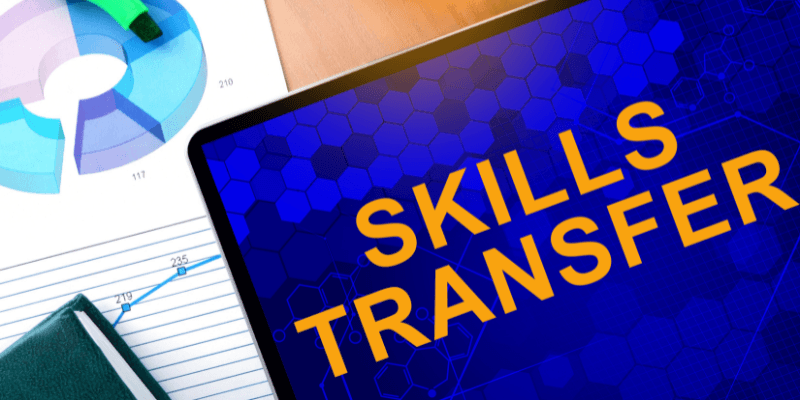
Changing career, or even just changing industry, can feel like starting from nothing. It isn’t. Most people already hold a set of transferable skills built up through work, education or life in general, they just haven’t stopped to ask what are transferable skills in their own case, or how to describe them to an employer.
What are transferable skills?
Transferable skills are abilities that move with you from one role, industry or situation to another, rather than being tied to one specific job. Project management, communication, budgeting, problem-solving and people management are all common transferable skills, because they’re useful in almost any working environment, technical or otherwise.
The transferable skills meaning gets used loosely, so it’s worth being clear on what it covers in practice. Getting the transferable skills meaning right matters more once you start applying for roles outside your usual field, since employers won’t always draw the connection for you. A transferable skill isn’t the same as a soft skill, even though the two overlap. Soft skills are personal traits and behaviours, such as adaptability or communication style. Transferable skills are broader, and can include practical, learned abilities too, such as data analysis or financial planning, provided they’re not locked to one specific employer’s systems or a narrow technical niche.

Transferable skills examples
Some of the clearest transferable skills examples come from roles that look completely unrelated on paper, which is often where the question of “What transferable skills do I have?” becomes clearest. A retail supervisor and a project coordinator, for instance, might both be strong at organising people, managing competing priorities and staying calm under pressure, even though their job titles suggest nothing in common.
A short transferable skills list covering the most commonly requested abilities includes:
- Communicating clearly with different audiences, whether that’s customers, colleagues or senior stakeholders
- Managing a budget, timeline or project, even an informal one
- Leading, training or supervising other people
- Solving problems with limited information or resources
- Adapting quickly when priorities or circumstances change
If you’re asking yourself, “What transferable skills do I have?”, the honest answer is usually more than you think. It’s a common question to get stuck on, mainly because most people describe their old job by its title rather than by what they actually did. The trick is looking past job titles and focusing on what you actually did day to day.
How to work out your own transferable skills
A useful way to pin down the transferable skills meaning is this: if you could plausibly do that part of your job in a completely different industry, it’s transferable. Everything else is either technical knowledge specific to one field, or a qualification tied to one particular role. Keeping that in mind makes it much easier to sort a long career history into what’s genuinely portable and what isn’t, and to build your own transferable skills list from scratch.
Start by listing what you actually spent your time doing in previous roles, rather than the job title itself. Break it down into tasks and responsibilities, then ask which of those would still be useful somewhere else entirely. Someone who ran a small retail team, for example, has almost certainly built genuine people management and scheduling skills that would transfer directly into hospitality, logistics or even office administration.
Turning transferable skills into a career change
Identifying your transferable skills is only half the job. The other half is proving them, ideally with something more concrete than a bullet point on a CV.
If you’re not sure how to approach picking up something new in an unfamiliar field, a short course like Improving Learning Skills is a low-commitment way to build that muscle before you take on anything bigger.
This is where a recognised qualification can help, particularly if you’re moving into a field where you don’t have direct experience yet. An Access to Higher Education Diploma is built for exactly this kind of change, giving you a formal route into higher education even if your background is in a completely different field. If your move is more about formalising existing people or leadership experience, a course like Business Communications or a recognised qualification such as the CMI Certificate in Sustainability Management and Leadership can turn skills you already use informally into something you can put a name to.
Transferable skills are, in many ways, the most valuable thing you bring to a career change, because they’re proof you can already do a large part of the job. The rest is usually just building the specific, technical knowledge to go with them, and if you want a broader look at the skills UK employers are short of right now, our guide to the UK skills gap is a good place to start. It’s also worth reading up on soft skills, since the two are easy to mix up but employers tend to ask for both.
Ready to take the next step?
Whichever skills gap you’re looking to close, the right next step doesn’t have to be a big commitment straight away. Browse the full range of free course brochures below to see what’s involved before you enrol, call the team on 01202 006 464 to talk through your options, or get in touch online and we’ll point you towards the right course for where you want to get to.