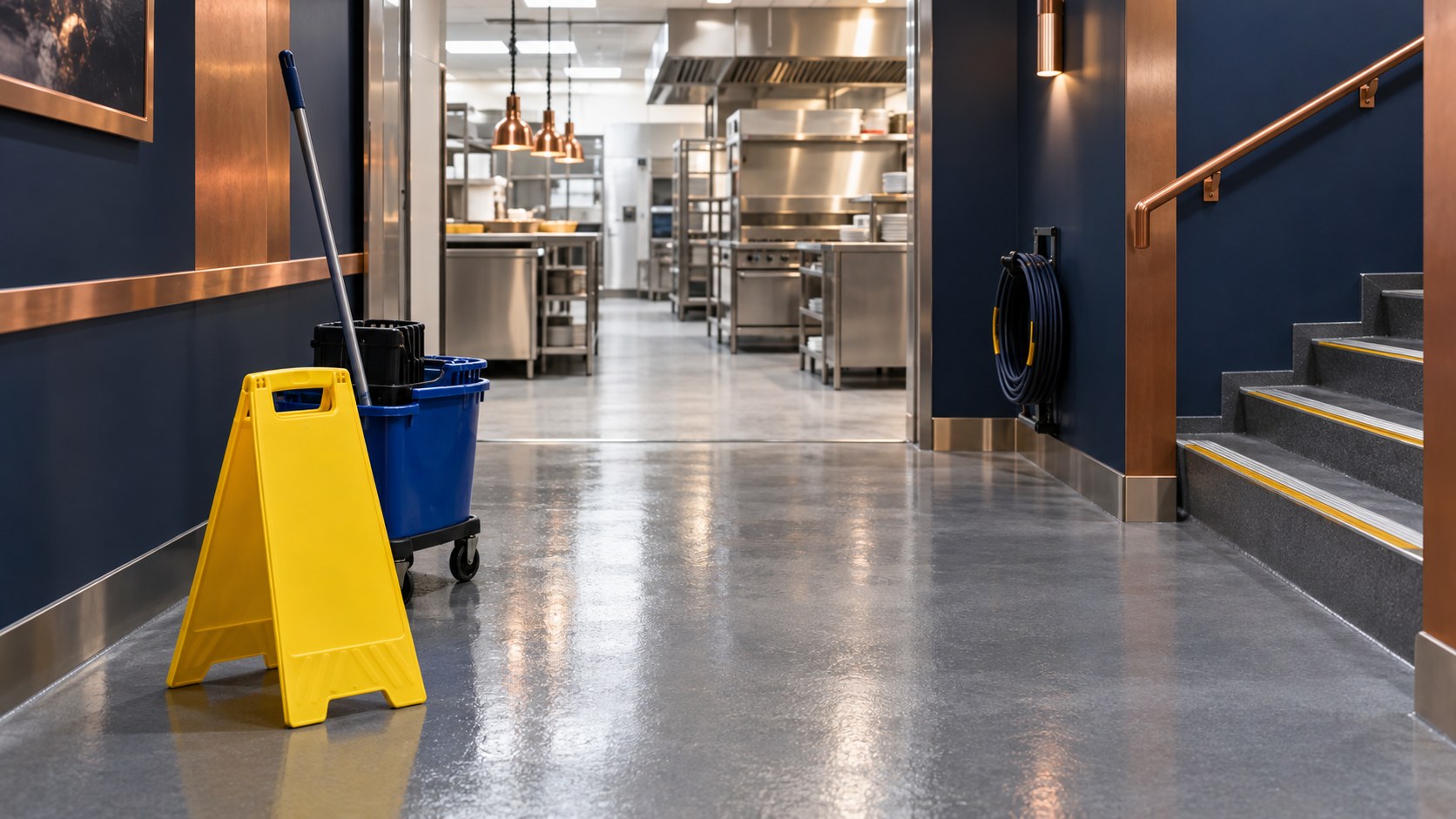
Slips, trips and falls training teaches staff why slips and trips happen, how to spot the hazards before someone gets hurt, and the everyday controls that prevent them: good housekeeping, prompt spill clean-up, suitable floors, sensible cleaning, the right footwear and safe behaviour. Slips, trips and falls on the same level are the single biggest cause of non-fatal injuries at work in Great Britain, accounting for 30% of employee injuries reported to HSE in 2024/25. No UK law names a specific slips, trips and falls course, but employers must assess the risk, keep floors and walkways safe, and give staff adequate health and safety training, so short awareness training is one of the simplest ways to meet those duties. This guide explains what the law actually requires, what HSE's evidence says about why people slip, real cases where it went wrong, and what the learndirect course covers.
This article focuses on slips, trips and falls on the same level. If your staff use ladders, stepladders, platforms or roofs, read our separate guide to working at height, which is covered by different regulations.
Slips, trips and falls: what the terms mean
- A slip happens when there is too little grip between your footwear and the floor. Most slips happen on floors that are wet or contaminated with something like grease, food, dust or talc.
- A trip happens when your foot hits an obstacle or a change in level, such as a trailing cable, a box in a walkway, a lifted mat, a pothole or an unmarked step.
- A fall on the same level is what usually follows a slip or trip: the person falls to the floor they were standing on. These falls cause fractures, head injuries and back injuries, and can knock over hot oil, glass or equipment.
- A fall from height is a fall from one level to a lower one, such as from a ladder, a stair or a loading bay edge. These cause most fall deaths at work and are controlled by the Work at Height Regulations 2005.
How big is the problem?
HSE's figures are clear:
- Employers reported 59,219 non-fatal injuries to employees under RIDDOR in 2024/25. Slips, trips or falls on the same level caused 30% of them, more than any other kind of accident. Falls from height caused a further 8% (HSE non-fatal injury statistics).
- Falls from height remain the most common cause of death at work. HSE's provisional figures for 2025/26 show 31 of the 126 workers killed in work-related accidents died after a fall from height (HSE fatal injury statistics).
- HSE says slips and trips cause over a third of all major injuries at work and over 40% of all reported injuries to members of the public (HSE, Assessing the slip resistance of flooring).
- HSE estimates that slip and trip accidents cost employers over GBP 500 million a year, and society over GBP 800 million, including GBP 133 million a year in health service costs (HSE, What do slip and trip accidents cost?).
You may still see claims that slips and trips cause "a third of over-three-day injuries". That figure dates from before 2012, when employers reported injuries causing more than three days off work. Since then the reporting threshold has been more than seven days, so use the current HSE figures instead.
What the law requires
Several pieces of law apply, and together they expect employers to manage slip and trip risk like any other hazard:
- Health and Safety at Work etc. Act 1974. Section 2 requires employers to provide a safe workplace, safe systems of work, and the information, instruction, training and supervision needed. Section 7 requires employees to take reasonable care of themselves and others and to cooperate with their employer.
- Management of Health and Safety at Work Regulations 1999. Regulation 3 requires a suitable and sufficient risk assessment, which should include slip and trip hazards. Regulation 13 requires adequate health and safety training on recruitment and when risks change.
- Workplace (Health, Safety and Welfare) Regulations 1992. Regulation 12 is the key slips and trips duty. Floors and traffic routes must be suitable, with no hole, slope, unevenness or slipperiness that exposes anyone to risk, and with effective drainage where necessary. So far as reasonably practicable, they must be kept free from obstructions and from anything that may cause a person to slip, trip or fall. Staircases need suitable handrails.
- Personal Protective Equipment at Work Regulations 1992. Where the risk assessment shows that slip-resistant footwear is needed, it counts as PPE and the employer must provide it. Under section 9 of the 1974 Act, employers cannot charge workers for it.
- Work at Height Regulations 2005. These apply wherever someone could fall a distance liable to cause injury, including from stepladders and stairs during work.
- RIDDOR 2013. Some slip and trip injuries must be reported to HSE (see "After a slip or trip accident" below).
No law sets a fixed refresher interval or requires one particular certificate. Be wary of any provider claiming its course is "required by law" or "approved by HSE".
Why people slip: what HSE's evidence shows
Slips are rarely just bad luck. HSE's guidance explains that people seldom slip on clean, dry floors. Most slips happen when a floor is wet or contaminated, and the risk depends on several things working together:
- Contamination: water, oil, grease, food, dust or talc on the floor. Stopping contamination at source is the most effective control.
- The floor surface: some floors are fine when dry but dangerous when wet. HSE uses the pendulum test to measure slip resistance. A Pendulum Test Value (PTV) of 36 or more indicates low slip potential, 25 to 35 moderate, and 24 or below high. Surface roughness matters too: for water-wet areas, roughness of 20 microns or more indicates low slip potential (HSE).
- Cleaning: the wrong cleaning method can make a floor more slippery, and a wet-mopped floor stays slippery until it is dry.
- Footwear: the right sole for the floor and the contamination makes a big difference.
- Environment: poor lighting, glare, rain or snow brought in on shoes, slopes, noise and distractions.
- People and behaviour: rushing, carrying loads that block the view, using phones while walking, and taking shortcuts.
When it goes wrong: two HSE case studies
Boiling oil in a fast food kitchen. After a busy Friday night, a cook walked across a floor that had just been wet-mopped. He slipped beside the deep fat fryer, grabbed it to break his fall, and pulled 35 litres of boiling oil over himself and the floor. He needed skin grafts for extensive burns, a colleague was also badly burned, and the trainee manager who dragged him clear burned his hands. The judge found that poor floor maintenance, poor cleaning, poor footwear and poor slip resistance of the floor tiles combined to make a slip more likely. The company was fined GBP 60,000 with GBP 16,000 costs (HSE case study).
A fractured skull in a store restaurant. A kitchen worker slipped on a tiled floor that quickly became contaminated with food, water and oily residue after the mats had been removed for cleaning. She fractured her skull, spent a long period in a high dependency unit and was unlikely to work again. Tests found the tiles and matting had unacceptably low slip resistance, and there had been four similar accidents in the same kitchen in the previous year. The employer was ordered to pay over GBP 36,000 including costs and had to replace the floor (HSE case study).
Both accidents were foreseeable. In both, staff and managers had the chance to spot the risk before someone was seriously hurt.
Practical ways to prevent slips and trips
Housekeeping and walkways
- Keep walkways, stairs and fire exits clear of boxes, bags, stock and waste.
- Route cables away from walkways, or cover them with proper cable protectors. Do not run them across doorways.
- Fix or report damaged flooring, lifted carpet, curled mats, loose tiles and potholes straight away.
- Mark changes in level and the edges of steps clearly.
Spills and cleaning
- Deal with spills immediately. A warning sign tells people about a hazard, but it does not remove it.
- Use a cleaning method that suits the floor, and follow the manufacturer's guidance.
- Keep people off wet-mopped floors until they are dry, or clean in sections and at quieter times.
- Stop contamination at source, such as leaking equipment, drips from ice machines, or rain brought in at entrances.
Floors, mats and lighting
- Choose flooring that keeps its grip in the conditions it will face, wet or greasy as well as dry.
- Use entrance matting that is big enough, lies flat and is itself slip resistant when wet.
- Make sure lighting is bright and even enough for people to see hazards, especially on stairs and outside.
- Grit or clear outdoor routes in icy weather, and fix poor drainage.
Footwear and behaviour
- Where the risk assessment calls for slip-resistant footwear, provide it free and replace it when the soles wear.
- Encourage people to walk, not run, use handrails, and keep one hand free on stairs.
- Avoid carrying loads that block your view. Our manual handling guide explains how to plan safer carries.
- Make it easy and normal for anyone to report a hazard, and act on the reports.
Who needs slips, trips and falls training?
- All staff, at induction. Every workplace has floors, stairs and walkways.
- Kitchen, catering and hospitality staff, where water, oil and food spills are constant.
- Cleaners, caretakers and facilities teams, whose choice of cleaning method directly affects slip risk.
- Retail, warehouse and distribution staff, who face spills, packaging, pallets and busy aisles.
- Health and social care staff, who also need to keep patients, residents and visitors safe.
- Managers, supervisors and duty holders, who carry out risk assessments and decide on floors, cleaning and footwear.
What the learndirect course covers
The learndirect Slips, Trips and Falls Training course is a CPD-accredited online course that takes about 60 minutes and is worth 1 CPD hour. It is suitable for induction or as a refresher, and covers six modules:
- Why slips, trips and falls matter at work
- The law and current legislation
- How slips, trips and falls happen
- Good housekeeping and floor quality
- Footwear and personal responsibility
- Safety precautions and workplace improvements
A final assessment checks that learners can identify common hazards and the correct precautions. Successful learners download a personalised certificate straight away, recognised by UK employers.
The course focuses on slips, trips and falls on the same level. It is not a ladder or work at height course. For staff who use ladders, stepladders or platforms, add Working at Heights and Ladder Safety Training. If they also carry loads, add Manual Handling Training.
The course costs GBP 25 per learner. For teams, 10 learners cost GBP 212.50, 25 learners GBP 468.75, 50 learners GBP 812.50 and 100 learners GBP 1,375.
After a slip or trip accident
- Look after the injured person. Call a first aider, or 999 for serious injuries. Do not move someone who may have a head, neck or back injury unless they are in immediate danger.
- Make the area safe so nobody else slips on the same spill or trips on the same obstacle.
- Record the accident in your accident book or reporting system.
- Check whether it is reportable under RIDDOR. A fracture other than to a finger, thumb or toe is a specified injury that must be reported, so a slip that breaks a wrist or an ankle counts. Injuries that keep a worker off normal duties for more than seven consecutive days, not counting the day of the accident, must be reported within 15 days (RIDDOR regulation 4). Injuries causing more than three days' incapacity must still be recorded.
- Investigate and fix the cause. Ask why the floor was wet, why the cable was there, or why the light was out, and update the risk assessment.
Common questions
Is slips, trips and falls training a legal requirement?
No law names a specific course. However, employers must assess slip and trip risks, keep floors and traffic routes safe under the Workplace Regulations, and give staff adequate health and safety training on induction and when risks change. Short awareness training is a practical way to show you have done this.
What is the most common cause of injury at work?
Slips, trips or falls on the same level. They caused 30% of non-fatal employee injuries reported to HSE in 2024/25, ahead of handling, lifting or carrying at 17%.
Do I have to report a slip at work to HSE?
Only if it meets the RIDDOR criteria. Fractures other than to fingers, thumbs or toes, and injuries that keep a worker off normal duties for more than seven consecutive days, must be reported. Other accidents should still be recorded and investigated.
Who pays for slip-resistant footwear?
If your risk assessment shows slip-resistant footwear is needed to control the risk, it is PPE and the employer must provide it free of charge.
How often should staff repeat the training?
There is no fixed legal interval. Most employers include it in induction, then refresh it periodically, after an accident, or when floors, tasks or premises change.
Can I refuse to work if a floor is dangerous?
You should report the hazard straight away. The Employment Rights Act 1996 (section 44 and section 100) protects workers who leave, or refuse to return to, a dangerous area where they reasonably believe the danger is serious and imminent and they could not reasonably be expected to avert it. It is not a general right to refuse any task you dislike, so raise concerns early and in writing.
Does the course cover ladders and working at height?
No. It focuses on slips, trips and falls on the same level. Use the Working at Heights and Ladder Safety Training course for ladders, stepladders and platforms.
Get your team trained
Most slips and trips are prevented by simple things done consistently: spills cleaned up straight away, walkways kept clear, the right floor and footwear, and people who notice and report hazards. The CPD-accredited learndirect Slips, Trips and Falls Training course gives every employee that awareness in about an hour, for GBP 25 per learner, with an instant certificate recognised by UK employers. For wider risk assessment duties, read our risk assessment training guide, or explore the full learndirect health and safety category.
Frequently asked
Is slips, trips and falls training a legal requirement?
No law names a specific course. However, employers must assess slip and trip risks, keep floors and traffic routes safe under the Workplace Regulations, and give staff adequate health and safety training on induction and when risks change. Short awareness training is a practical way to show you have done this.
What is the most common cause of injury at work?
Slips, trips or falls on the same level. They caused 30% of non-fatal employee injuries reported to HSE in 2024/25, ahead of handling, lifting or carrying at 17%.
Do I have to report a slip at work to HSE?
Only if it meets the RIDDOR criteria. Fractures other than to fingers, thumbs or toes, and injuries that keep a worker off normal duties for more than seven consecutive days, must be reported. Other accidents should still be recorded and investigated.
Who pays for slip-resistant footwear?
If your risk assessment shows slip-resistant footwear is needed to control the risk, it is PPE and the employer must provide it free of charge.
How often should staff repeat the training?
There is no fixed legal interval. Most employers include it in induction, then refresh it periodically, after an accident, or when floors, tasks or premises change.
Can I refuse to work if a floor is dangerous?
You should report the hazard straight away. The Employment Rights Act 1996 protects workers who leave, or refuse to return to, a dangerous area where they reasonably believe the danger is serious and imminent and they could not reasonably be expected to avert it. It is not a general right to refuse any task, so raise concerns early and in writing.
Does the course cover ladders and working at height?
No. It focuses on slips, trips and falls on the same level. Use the Working at Heights and Ladder Safety Training course for ladders, stepladders and platforms.
Sources and further reading
- Non-fatal injuries at work in Great Britain (HSE)
- Work-related fatal injuries in Great Britain (HSE)
- Assessing the slip resistance of flooring (HSE)
- What do slip and trip accidents cost? (HSE)
- Injury caused by a slip in a kitchen (HSE case study)
- Fractured skull from a wholly preventable catering slip (HSE case study)
- Workplace (Health, Safety and Welfare) Regulations 1992, regulation 12 (legislation.gov.uk)
- Management of Health and Safety at Work Regulations 1999, regulation 3 (legislation.gov.uk)
- Health and Safety at Work etc. Act 1974, section 2 (legislation.gov.uk)
- RIDDOR 2013, regulation 4 (legislation.gov.uk)
- Employment Rights Act 1996, section 44 (legislation.gov.uk)