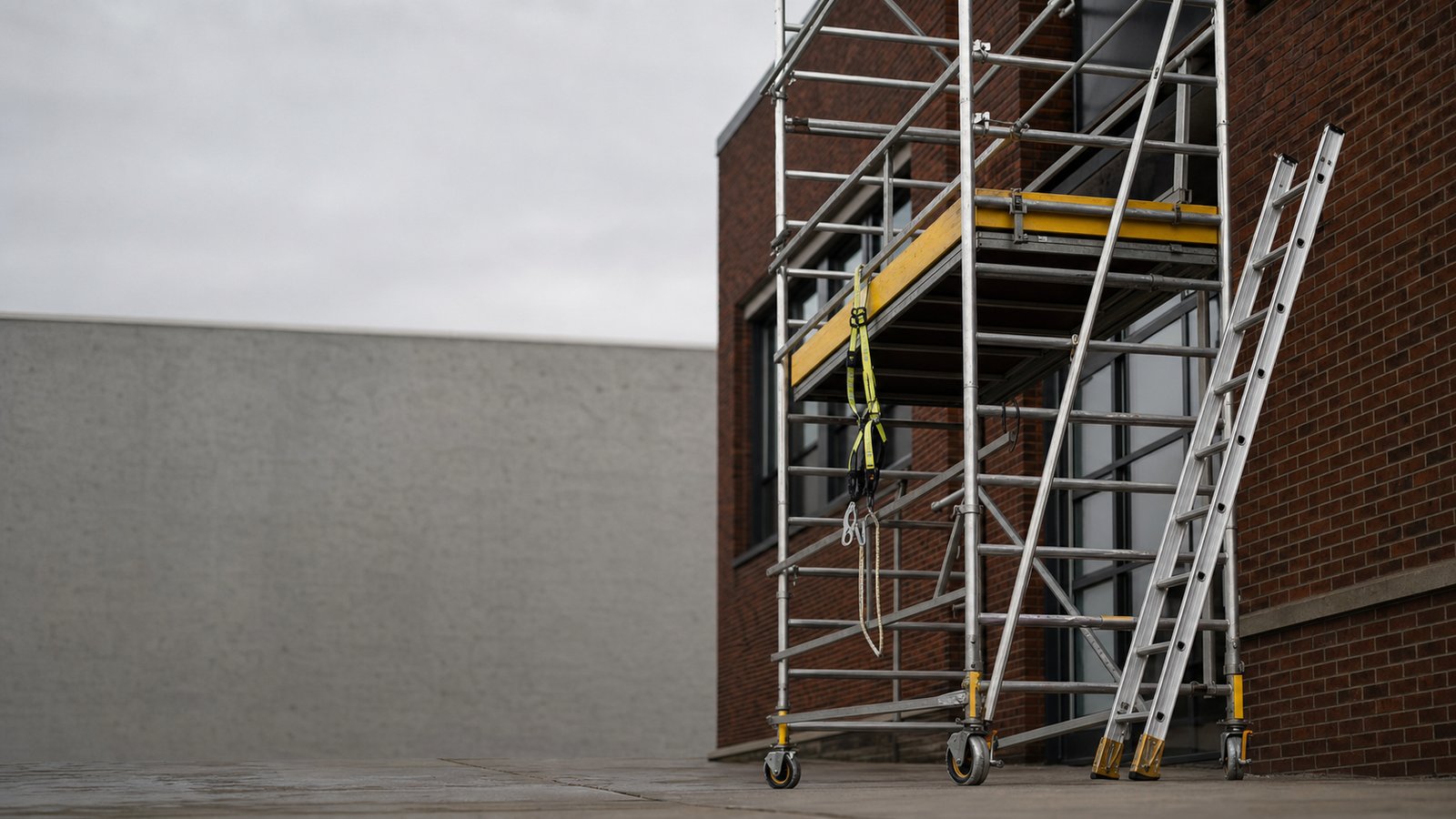
Working at height is one of the highest-risk activities in any UK workplace. It is governed by the Work at Height Regulations 2005 (WAHR), which sit under the Health and Safety at Work etc. Act 1974 and require every employer, and every person in control of work at height, to plan and organise that work, use competent people, and select the right equipment. This guide explains what the law actually says, how the current statistics look, what a training course should cover, and where the learndirect online course fits into a proper working-at-height programme.
What the Regulations actually say
HSE's INDG401 "Working at height: A brief guide" defines work at height as work in any place where, if there were no precautions in place, a person could fall a distance liable to cause personal injury. There is no minimum height threshold under WAHR. A common misconception is that the Regulations only apply above 2 metres; HSE has been clear since 2007 that this is not the case. Working on a stepladder in a stockroom, on a low platform, on a flat roof, or near an opening in a floor is all work at height if a fall is possible.
Another persistent misconception is that ladders and stepladders are banned. They are not. HSE says explicitly in INDG401 that there are many situations where a ladder is the most suitable piece of equipment for working at height. What the law requires is a considered choice based on risk, not a blanket ban on any particular type of equipment.
The Regulations require every employer and every person in control of work at height to:
- Avoid work at height where it is reasonably practicable to do so.
- Where work at height cannot be avoided, prevent falls using an existing safe place of work or the right type of equipment.
- Minimise the distance and consequences of a fall where the risk cannot be eliminated.
- Ensure work is properly planned, appropriately supervised and carried out by competent people.
- Plan for emergencies and rescue; you cannot rely entirely on the emergency services.
The scale of the risk in Great Britain
Falls from height are the single largest cause of fatal workplace injury in Great Britain and have been in almost every year since 2001/02. HSE's latest published figures (Work-related fatal injuries in Great Britain, published July 2026, covering 2025/26) show:
- 126 workers killed in work-related accidents in 2025/26.
- 31 of those deaths were caused by falls from a height, around 25% of all worker fatalities.
- The five-year average is 38 fatal falls per year, or 28% of all worker fatalities across 2020/21 to 2024/25.
- The proportion is even higher in construction: falls from height account for over half of construction fatalities on the five-year average.
The non-fatal picture is just as significant. HSE's 2024/25 statistics record 4,684 employer-reported (RIDDOR) falls from height, around 8% of all reported non-fatal accidents at work. Up to 44,000 workers self-reported a fall-related injury in the same period. These are not all catastrophic, but a fall of even a modest height on to a hard surface routinely produces fractures, spinal injuries and head injuries.
The reason the topic keeps coming up in HSE enforcement notices is that a very high proportion of these deaths and serious injuries are avoidable with proper planning, the right equipment, and a competent workforce.
Who has legal duties under WAHR?
Duties apply to employers, the self-employed and anyone who controls work at height (for example a contractor or a factory owner). Workers themselves also have duties: they must report anything they know is likely to endanger themselves or others, use any equipment properly, and follow training and instructions.
Directors and senior managers can be held personally liable under section 37 of the Health and Safety at Work etc. Act 1974 where an offence is committed with their consent, connivance or neglect. In practice, HSE enforcement following a serious fall regularly extends beyond the site operative to supervisors and company directors.
The hierarchy of control
WAHR is built on a strict hierarchy that every plan for work at height should follow, in order:
- Avoid. Can the task be redesigned so nobody has to work at height at all? Long-reach tools, pre-fabrication at ground level, mounting fittings at low level then raising the whole assembly, and remote inspection cameras all belong here.
- Prevent a fall. If avoidance is not reasonably practicable, prevent the fall using collective protection first: guardrails, working platforms, mobile elevating work platforms (MEWPs), scaffolds, and secure existing places of work such as flat roofs with permanent edge protection.
- Minimise the distance and consequences of a fall. Only where the fall cannot be prevented outright, use collective fall-arrest (soft-landing systems, safety nets, airbags) before personal fall-arrest equipment. A harness and lanyard is the last line, not the first.
HSE stresses that collective protection (equipment that protects everyone in the area without them having to do anything) always comes before personal protection (equipment that only protects the individual and only if they use it correctly).
What a Working at Height training course should cover
A knowledge-based Working at Height training course should give a learner a working understanding of the following:
- The legal framework. Work at Height Regulations 2005, Health and Safety at Work etc. Act 1974, the role of HSE, and the duties of employers, controllers of work at height, and workers.
- The hierarchy of control. Avoid, prevent, minimise: what each step means in practice, and why collective protection precedes personal protection.
- Risk assessment and planning. Identifying hazards (fragile surfaces, exposed edges, weather, falling objects), assessing risk, and writing a suitable and sufficient plan.
- Selecting equipment. Ladders and stepladders (when they are and are not appropriate), podium steps, tower scaffolds, fixed scaffolds, MEWPs, and personal fall-protection systems.
- Ladders and stepladders in detail. The pre-use check, correct angle (1 in 4), securing the top and bottom, three points of contact, load limits, and the 30-minute short-duration test HSE uses for judging whether a ladder is appropriate.
- Working on fragile surfaces. Roof lights, liner panels, non-reinforced fibre cement sheets, corroded metal sheets, glass, rotted chipboard, and slate or tile roofs. Fragile roof falls are one of the most common causes of workplace death.
- Personal fall-protection equipment. Full-body harnesses, energy-absorbing lanyards, work-restraint versus fall-arrest, anchor points, and free-fall distance calculations.
- Rescue and emergency planning. Suspension trauma, why immediate rescue is critical for anyone suspended in a harness, and why HSE does not accept "call 999" as a full rescue plan.
- Inspection and maintenance. Pre-use checks, formal periodic inspections, and record-keeping requirements for ladders, scaffolds, MEWPs and personal equipment.
- Reporting. Near-miss reporting, dangerous occurrences, and the RIDDOR duty to report falls from height that meet the reporting threshold.
Where the learndirect online course fits
The learndirect Working at Heights and Ladder Safety Training course is an online, CPD-accredited knowledge course. It takes around 60 minutes to complete, awards 1 CPD hour, and delivers an instant downloadable CPD certificate on completion. Priced at £25 per learner plus VAT, it is designed to give teams the confidence to assess risk, choose the right equipment and prevent falls whenever work involves ladders or height access.
It is honest about what it is and what it is not:
- What it is: a solid grounding in the legal framework, the hierarchy of control, ladder safety, risk assessment and rescue planning. Suitable for whole-workforce awareness roll-outs, induction for new starters, an annual refresher for occasional users of ladders and platforms, and a shared vocabulary for teams that plan work at height.
- What it is not: a substitute for hands-on practical training in a specific piece of equipment such as MEWPs (IPAF), tower scaffolds (PASMA), advanced rope access (IRATA) or personal fall-arrest systems. Those tickets require practical assessment and cannot be delivered fully online. If a first-aid needs assessment for work at height identifies that hands-on competence is required, book a practical course with a competent provider.
Used properly, the online course sits alongside practical qualifications. A typical pattern for a small construction or maintenance team is: everyone completes the £25 online course as a shared foundation; operatives who use towers or MEWPs then attend the relevant hands-on ticket; supervisors receive additional planning-and-supervision training. The online course keeps the whole team's knowledge fresh between refreshers, without pulling every operative off site for a full classroom day.
Practical steps for employers
- Start with a written work-at-height risk assessment. HSE expects one; the assessment drives every subsequent decision on equipment, supervision and training. INDG401 gives a straightforward framework.
- Apply the hierarchy in order. Do not jump straight to harnesses. Ask first whether the work can be avoided, then whether a collective platform will do the job, and only then consider personal fall-arrest.
- Plan the rescue before the work starts. If your rescue plan for a suspended worker is "call 999", it is not a plan. Suspension trauma can be life-threatening within minutes. Any use of harnesses on site needs a documented, rehearsed rescue procedure and the equipment to execute it.
- Inspect equipment properly. Ladders and stepladders need a pre-use visual check every time, and a formal periodic inspection recorded. Scaffolds must be inspected on erection, weekly, and after any event likely to affect stability. Personal fall-protection equipment needs a documented periodic examination by a competent person.
- Train, don't just tell. Toolbox talks are not a substitute for training. A knowledge course (like the £25 learndirect course) sets the baseline; practical tickets cover the specific equipment your teams use.
- Refresh regularly. Knowledge fades, regulations move, and personnel change. An annual refresher for the wider workforce and a review of practical tickets before they expire keeps the whole system current.
Frequently asked
Is Working at Height training a legal requirement?
The Work at Height Regulations 2005 do not name a specific course. What they require is that anyone carrying out work at height is competent, which the Regulations define as having sufficient skills, knowledge and experience. Where knowledge is the gap, training is how employers close it. For low-risk short-duration ladder work, HSE accepts on-the-job instruction; for more technical work such as complex scaffolds, recognised certification schemes are the usual route. In practice, training is the standard way to evidence competence and is expected by HSE, principal contractors and insurers.
Do the Regulations only apply above 2 metres?
No. This is one of the most common misconceptions about the Work at Height Regulations 2005. HSE has been explicit since 2007 that there is no minimum height threshold in the Regulations. Work at height is any work where a person could fall a distance liable to cause personal injury. That includes low platforms, stepladders in stockrooms, and openings in floors. A fall of less than a metre onto a concrete floor can be fatal, particularly for older workers.
Are ladders and stepladders banned under WAHR?
No. HSE addresses this misconception explicitly in INDG401 "Working at height: a brief guide". There are many situations where a ladder is the most suitable piece of equipment for working at height, particularly for low-risk short-duration tasks (HSE defines short duration as taking less than 30 minutes). What the Regulations require is a proper choice based on the risk of the task, not a blanket ban on any specific equipment.
How many people die from falls at work in the UK?
Falls from height are the single largest cause of fatal workplace injury in Great Britain and have been in almost every year since 2001/02. HSE's latest published statistics (2025/26, released July 2026) record 126 worker fatalities in total, of which 31 were falls from a height, around 25% of all worker deaths. The five-year average is 38 fatal falls per year, or 28% of all worker fatalities. In construction the proportion is higher: falls from height account for over half of construction fatalities on the five-year average.
What is the hierarchy of control for work at height?
The Work at Height Regulations 2005 require a strict hierarchy. First, avoid work at height where it is reasonably practicable to do so; ask whether the task can be redesigned so nobody has to be at height. Second, where work at height cannot be avoided, prevent falls using collective protection such as guardrails, working platforms, MEWPs, tower scaffolds or fixed scaffolds. Third, only where the fall cannot be prevented, minimise the consequences with collective fall-arrest (nets, airbags) before personal fall-arrest equipment (harness and lanyard). Personal protection is the last line, not the first.
Is a rescue plan really a legal requirement?
Yes. Regulation 4(1) of the Work at Height Regulations 2005 requires that work at height is properly planned, including emergency and rescue procedures. HSE guidance in INDG401 is clear that you should not rely entirely on the emergency services for rescue. Suspension trauma can be life-threatening within minutes for a worker suspended motionless in a harness; the ambulance response time is likely to be longer than that. Where harnesses are used, a documented and rehearsed rescue plan with the right equipment and trained personnel is a legal minimum, not a nice-to-have.
Does the learndirect online course replace practical training?
No, and it is not designed to. The learndirect Working at Heights and Ladder Safety Training course is a CPD-accredited online knowledge course of around 60 minutes. It gives learners a solid grounding in the legal framework, the hierarchy of control, ladder safety, risk assessment and rescue planning. It is a strong fit for induction, workforce awareness, refreshers and shared vocabulary across a team. It is not a substitute for hands-on practical tickets such as PASMA (mobile tower scaffolds), IPAF (MEWPs) or IRATA (rope access); those require practical assessment on real equipment and cannot be delivered fully online.
How long is the learndirect Working at Heights certificate valid?
The CPD certificate awarded by the learndirect course does not carry a formal expiry date. In practice, best practice across the industry is to refresh working-at-height knowledge every one to two years, and any hands-on practical ticket (PASMA, IPAF, IRATA) has its own defined validity period, typically three to five years. Employers should schedule refreshers against the earlier of any practical-ticket expiry and their own risk-assessed refresh cadence.
Sources and further reading
- HSE INDG401 (rev2): Working at height - A brief guide
- HSE: Work at height - the law
- HSE: Working at height (topic hub)
- HSE: Work-related fatal injuries in Great Britain, 2025/26 press release
- HSE: Kinds of accident causing injury in Great Britain
- Work at Height Regulations 2005 (legislation.gov.uk)
- Health and Safety at Work etc. Act 1974
- learndirect Working at Heights and Ladder Safety Training