Yes. Manual handling training is a legal requirement under UK health and safety law. Every UK employer whose staff lift, lower, push, pull, carry or move loads by hand or bodily force must ensure those workers have been trained to do so safely. This duty comes from the Manual Handling Operations Regulations 1992 and the Health and Safety at Work etc. Act 1974, and it applies whether you run a warehouse, a care home, a school, an office, a construction site or a small retail shop. Failure to train staff, assess risk and reduce injury exposure can result in unlimited fines and, in the most serious cases, imprisonment.
What is manual handling?
The Manual Handling Operations Regulations 1992 (MHOR) define manual handling as "any transporting or supporting of a load (including the lifting, putting down, pushing, pulling, carrying or moving thereof) by hand or bodily force." That definition is deliberately broad. It covers office workers moving boxes of paper, warehouse operatives loading pallets, care staff supporting service users, retail staff restocking shelves and construction workers moving materials.
Manual handling injuries are one of the biggest causes of workplace ill health in the UK. According to the Health and Safety Executive (HSE), an estimated 511,000 workers suffered from a work-related musculoskeletal disorder in 2024/25, and 7.1 million working days were lost as a direct result. Manual handling is one of the main causes. These injuries are also disproportionately expensive: the average case results in around 14 days lost, and back injuries alone account for 41% of days lost to work-related musculoskeletal disorders.
UK legal requirement: the Manual Handling Operations Regulations 1992
Under the Manual Handling Operations Regulations 1992, employers have three duties, applied in strict order:
1. Avoid hazardous manual handling where reasonably practicable
The first duty is avoidance. If a task can be redesigned, mechanised or eliminated altogether, that is the employer's legal starting point. Trolleys, hoists, conveyors, powered pallet trucks, sack barrows and load-lifting equipment must be considered before any human lift.
2. Assess the risk of manual handling that cannot be avoided
Where handling cannot be avoided, employers must carry out a suitable and sufficient risk assessment of the tasks that remain. This must consider the four MHOR risk factors: the task itself, the load being handled, the working environment, and the individual capability of the worker. HSE publishes the Manual Handling Assessment Charts (MAC tool) and the Assessment of Repetitive Tasks (ART tool) to help employers meet this duty.
3. Reduce the risk of injury so far as is reasonably practicable
Where risk remains after assessment, employers must reduce it to the lowest level reasonably practicable. That includes providing lifting aids, redesigning workstations, adjusting shift patterns and, critically, providing manual handling training and information to the workers who carry out the task.
Consequences of non-compliance
Breaches of the Manual Handling Operations Regulations 1992 are prosecuted under the Health and Safety at Work etc. Act 1974. Since 12 March 2015, both magistrates' courts and Crown Courts have the power to impose unlimited fines for health and safety offences. Individual directors, managers and employees can also face:
- Up to 6 months' imprisonment on summary conviction in a magistrates' court.
- Up to 2 years' imprisonment on indictment in the Crown Court.
- Personal fines in addition to any corporate fine.
- Improvement notices and prohibition notices from HSE inspectors, which are published on the HSE public register.
- Civil compensation claims from injured workers, typically in the tens of thousands of pounds per case.
What does manual handling training cover?
Effective manual handling training goes well beyond "bend your knees, not your back." A compliant course covers the legal framework, the physiology of injury, and the practical techniques that reduce risk in the workplace.
Legal framework and employer duties
Workers should understand what MHOR requires, what their own duties are under section 7 of the Health and Safety at Work Act (to take reasonable care and to follow safe systems of work), and where the risk assessments for their role are kept.
Anatomy of the spine and how injuries happen
Training should explain how the spine, discs, muscles and ligaments respond to load, twist and repetition, so that workers understand why the techniques matter. Cumulative micro-injuries from repeated poor lifting are as damaging as a single overload event.
Risk assessment: TILE and TILEO
The TILE (Task, Individual, Load, Environment) and TILEO (adding Other factors) framework gives workers a memorable structure for assessing a lift on the spot, before they start. HSE's MAC tool builds on the same four risk factors.
HSE guideline weights
UK law does not set a legal maximum weight for a single lift, but the HSE publishes guideline figures in its risk filter. For loads held close to the body, the guideline maximum is 25 kg for men and 16 kg for women at knuckle height. These figures reduce sharply the further the load is from the body or the higher and lower it is lifted. At head height, the guideline drops to 10 kg for men and 7 kg for women. These are guideline figures for lower-risk lifts, not safe legal limits, and any lift outside them requires a more detailed assessment.
Safe lifting technique
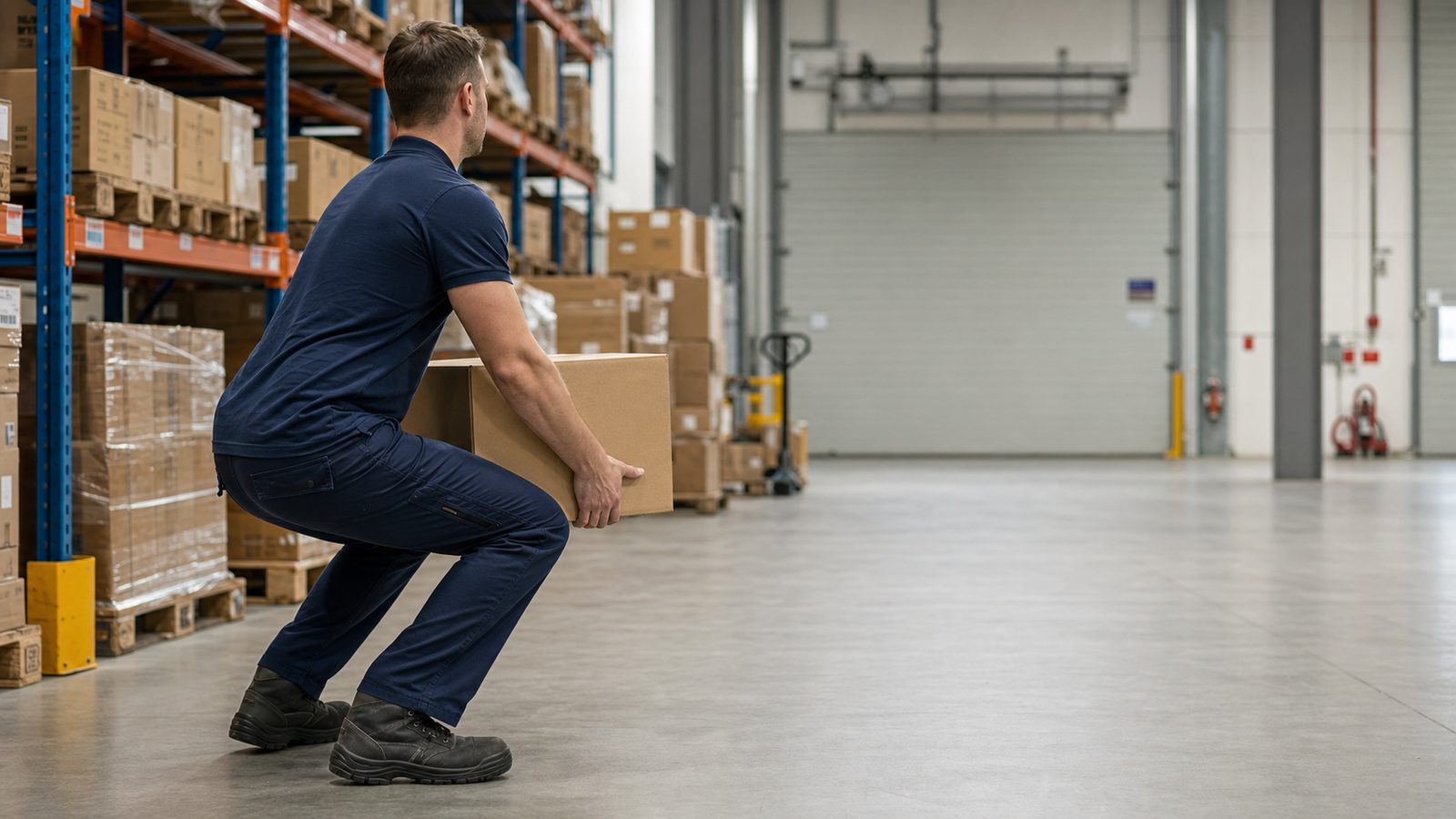
- Plan the lift and clear the route.
- Position the feet, one slightly forward, hip-width apart.
- Bend at the hips and knees, keeping the back in its natural curve.
- Get a firm grip and hold the load close to the body.
- Lift smoothly by straightening the legs, keeping the head up.
- Move the feet to turn - never twist the spine while under load.
- Lower using the same technique in reverse.
Team lifting, pushing and pulling
Training must also cover coordinated team lifts (where two or more people share a load), pushing and pulling of trolleys and wheeled loads, and the use of lifting aids such as sack trucks, pallet trucks and hoists.
Individual capability and vulnerable workers
Employers must take account of pregnancy, existing injury, age, height, physical strength and any known health conditions. Training should make clear that workers have a right to refuse a lift that puts their health at risk, and a duty to report any condition that affects their capability.
Moving and handling vs manual handling: is there a difference?
In UK law, no. "Manual handling" is the term used in the Manual Handling Operations Regulations 1992 (MHOR) and by HSE guidance. "Moving and handling" is the term more commonly used in healthcare and social care, where the "load" is often a patient or service user rather than a box or pallet. Both describe the same underlying duty and the same legal framework. If your course records say "moving and handling training" and your HSE inspector or claims solicitor asks for "manual handling training", they mean the same thing.
In practice the two labels tend to signal a slightly different training emphasis:
- Manual handling training is the general workplace course. It focuses on loads and inanimate objects: boxes, stock, tools, materials, equipment. It is the standard course for warehousing, logistics, retail, manufacturing, construction and offices.
- Moving and handling training (sometimes called "moving and handling of people" or "patient handling") is the healthcare and care sector course. It focuses on assisting patients and service users to sit, stand, walk, transfer between surfaces, reposition in bed and use mobility aids. It sits on top of the general manual handling foundations and adds people-specific technique, dignity, communication and safeguarding.
Under MHOR both are treated as manual handling and both require the same avoid, assess, reduce approach. Employers in health and social care usually deliver both: a general manual handling module for stock and equipment, plus a moving and handling of people module for direct care tasks. The Care Quality Commission (CQC) and Care Inspectorate in Scotland expect providers to evidence both where relevant to the service.
Moving and handling of people: what care and healthcare workers need
Moving and handling of people is one of the highest-risk activities in UK healthcare and social care. The HSE moving and handling in health and social care guidance is explicit that patient handling injuries are a leading cause of work-related musculoskeletal disorder in nursing, care and allied health roles, and that these injuries are largely preventable with correct training, equipment and assessment.
A moving and handling of people course extends general manual handling training to cover:
- Person-centred risk assessment - documenting the individual's weight, mobility, medical conditions (stroke, dementia, arthritis, tissue viability), pain, cognitive capacity and ability to cooperate before every transfer. This assessment lives in the care plan and must be reviewed after any material change.
- Mechanical aids - safe use, inspection and maintenance of mobile hoists, ceiling track hoists, stand aids, slide sheets, transfer boards, banana boards, turn discs and hi-lo beds. Under LOLER 1998, lifting equipment used to lift people must be thoroughly examined every 6 months by a competent person and defects must be reported and rectified before further use.
- Sit-to-stand and stand-to-sit transfers - with and without a stand aid, using verbal prompts, appropriate footwear and correct positioning.
- Bed mobility - rolling, sitting up, moving up the bed and repositioning using slide sheets rather than dragging, which is the single most common cause of skin damage and staff back injury in bed care.
- Bed to chair, chair to toilet and floor recovery - the four transfer types where hoist use is most likely to be indicated, and how to identify the correct sling size, loop configuration and hoist type for the individual.
- Falls and controlled descent - how to guide, not catch, a falling person. Catching a falling patient is the single most common cause of acute back injury in care staff. Recognised technique is to protect the head, guide the descent and, once the person is safely on the floor, use a hoist or emergency lifting cushion to raise them.
- Communication and dignity - explaining every step to the person being moved, seeking consent, using their preferred name, maintaining dignity and privacy, and recording any refusal.
- Bariatric care - additional assessment, equipment (heavier duty hoists, wider beds, bariatric slings) and staff numbers required for people over standard weight limits.
- Safeguarding trigger - recognising when unsafe or undignified moving and handling meets the safeguarding threshold under the Care Act 2014.
Practical moving and handling of people training must include a supervised competency assessment on the equipment actually used in the workplace. An online knowledge module alone is not enough for staff who transfer patients. HSE, CQC and the Royal College of Nursing all expect a blended approach: knowledge learning online, then supervised practical training and competency sign-off before the worker performs unsupervised transfers.
Who needs manual handling training?
Any UK worker whose job includes lifting, carrying, pushing, pulling or supporting a load needs manual handling training. In practice, that covers most workplaces:
- Warehousing, logistics and distribution - picking, packing, loading, unloading, pallet handling.
- Health and social care - see the moving and handling of people section above for patient handling; general manual handling training covers the equipment, supplies and stock these workers also handle daily.
- Construction and trades - materials handling, tools, bagged aggregates, boards and beams.
- Retail and hospitality - deliveries, stock replenishment, back-of-house handling, waste and recycling.
- Manufacturing and production - components, tools, jigs, finished goods.
- Cleaning and facilities - equipment, chemicals, waste containers.
- Offices and schools - moving furniture, boxes, deliveries, event set-up.
- Delivery drivers, couriers and field engineers - loading and unloading vehicles multiple times a day.
When must you have manual handling training?
Manual handling training must be in place before a worker is exposed to a manual handling task that has been identified as carrying a risk of injury. In practice, this means:
- At induction, for every new starter whose role includes any manual handling.
- When the task changes - new equipment, new loads, new environment, new premises.
- After an incident or near miss, as part of the corrective action.
- On a refresher cycle. HSE does not set a legally fixed interval, but 2-3 years is standard industry practice, and higher-risk roles often refresh annually.
- When individual capability changes - return to work after injury, pregnancy or long-term illness.
Training must be documented. Employers should keep completion certificates, attendance records and assessment scores for every worker, and be able to produce them on request from an HSE inspector or a claims solicitor.
Common questions about manual handling training
Is manual handling training a legal requirement in the UK?
Yes. The Manual Handling Operations Regulations 1992 require employers to provide information, instruction and training to any worker exposed to a risk of injury from manual handling. The Health and Safety at Work etc. Act 1974 provides the framework for enforcement and penalties.
What is the difference between moving and handling training and manual handling training?
They describe the same legal duty under the Manual Handling Operations Regulations 1992. "Manual handling" is the general workplace term used by HSE. "Moving and handling" is the label used in healthcare and social care, where the load is usually a person rather than an object. In healthcare and care settings, staff typically need both a general manual handling module for stock and equipment and a moving and handling of people module covering hoists, slide sheets, transfers and falls.
How long does manual handling training take?
An online manual handling course typically takes around 60 minutes to complete, followed by a short assessment. Practical, workplace-specific training on lifting aids and site-specific tasks should be delivered separately by a competent person.
How often should manual handling training be refreshed?
HSE does not set a legal refresher period, but every 2-3 years is standard practice. Higher-risk roles (warehouse, care, construction) should refresh annually, and refresher training should always follow any incident, near miss or change in equipment or process.
Is there a legal maximum weight for manual handling in the UK?
No. UK law does not set a legal maximum weight. The HSE publishes guideline figures (25 kg for men, 16 kg for women at knuckle height, held close to the body) as a starting point for risk assessment, but these are guidelines only. The legal test is whether the risk of injury has been reduced so far as is reasonably practicable.
Does manual handling training count as evidence of compliance?
Training is one part of compliance. Employers also need a documented risk assessment, safe systems of work, appropriate lifting equipment, supervision and evidence that identified controls are in place and being followed. A training certificate on its own does not discharge the duty under MHOR.
Do office workers need manual handling training?
Yes, wherever their role includes moving loads by hand or bodily force. Moving boxes of paper, setting up meeting rooms, receiving deliveries, handling laptops and screens, or supporting events all fall within scope. The risk may be lower than in a warehouse, but the legal duty is the same.
Train your staff online with learndirect
Our online Manual Handling Training course is CPD-certified and takes around 60 minutes to complete. It covers the legal framework, spine anatomy, TILE risk assessment, HSE guideline weights, safe lifting technique, pushing and pulling, team lifting and individual capability. Learners receive a downloadable certificate on completion, valid as documented evidence for HSE inspections, insurance renewals and client audits.
The course is priced at £25 per learner, with bulk discounts and multi-user administration available for teams. Book online today, or explore our full health and safety training library for related courses in fire safety, first aid, DSE, working at height and more.
Frequently asked
Is manual handling training a legal requirement in the UK?
Yes. The Manual Handling Operations Regulations 1992 require employers to provide information, instruction and training to any worker exposed to a risk of injury from manual handling. The Health and Safety at Work etc. Act 1974 provides the enforcement framework, and breaches can result in unlimited fines and imprisonment.
What is the difference between moving and handling training and manual handling training?
They describe the same legal duty under the Manual Handling Operations Regulations 1992. "Manual handling" is the general workplace term used by HSE. "Moving and handling" is the label used in healthcare and social care, where the load is usually a person rather than an object. In healthcare and care settings, staff typically need both a general manual handling module for stock and equipment and a moving and handling of people module covering hoists, slide sheets, transfers and falls.
How long does manual handling training take?
An online manual handling course typically takes around 60 minutes to complete, followed by a short assessment. Practical, workplace-specific training on lifting aids and site-specific tasks should be delivered separately by a competent person on site.
How often should manual handling training be refreshed?
HSE does not set a legal refresher period, but every 2-3 years is standard practice. Higher-risk roles such as warehouse, care and construction should refresh annually, and refresher training should follow any incident, near miss or change in equipment or process.
Is there a legal maximum weight for manual handling in the UK?
No. UK law does not set a legal maximum weight. The HSE publishes guideline figures (25 kg for men, 16 kg for women at knuckle height, held close to the body) as a starting point for risk assessment, but these are guidelines only. The legal test is whether the risk of injury has been reduced so far as is reasonably practicable.
Does an online course satisfy the legal duty on its own?
Not on its own. Online training provides the theory, legal framework and generic technique. Employers must also carry out a documented site-specific risk assessment, provide any necessary lifting equipment, supervise the work and give practical instruction on their own equipment and premises. Together those elements discharge the MHOR duty.
Do office workers need manual handling training?
Yes, wherever their role includes moving loads by hand or bodily force. Moving boxes of paper, setting up meeting rooms, receiving deliveries, handling laptops and screens or supporting events all fall within scope. The risk profile is lower than a warehouse, but the legal duty is the same.
Sources and further reading
- Manual Handling Operations Regulations 1992 (legislation.gov.uk)
- Health and Safety at Work etc. Act 1974 (legislation.gov.uk)
- HSE: Manual handling at work
- HSE: Moving and handling in health and social care
- Lifting Operations and Lifting Equipment Regulations 1998 (legislation.gov.uk)
- HSE work-related musculoskeletal disorders statistics 2024/25
- learndirect Manual Handling Training