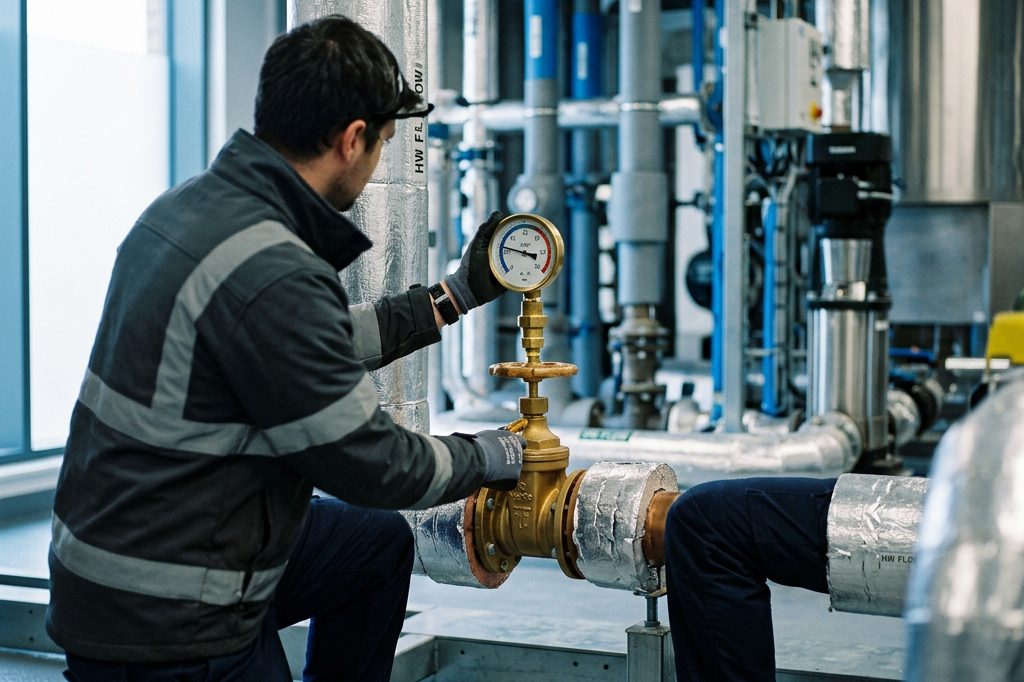
Yes. Legionella training is not a stand-alone legal duty with its own Act of Parliament, but it is a firm legal requirement for anyone who manages, maintains or works with hot and cold water systems in a workplace. The duty is built from the Health and Safety at Work etc. Act 1974, the Control of Substances Hazardous to Health Regulations 2002 (COSHH), and the practical rulebook the Health and Safety Executive uses at inspection: the Approved Code of Practice L8, "Legionnaires' disease: The control of legionella bacteria in water systems", and its supporting HSG274 Parts 1 to 3 guidance. Together, these place a personal duty on the "responsible person" for a water system to be competent, to appoint competent staff, and to keep records. Legionella awareness training is the standard way to evidence that competence.
The legal framework in plain English
There is no single "Control of Legionella Regulations". Instead, four instruments operate together, and each one bites at inspection.
Health and Safety at Work etc. Act 1974
Section 2 places a general duty on every employer to ensure, so far as is reasonably practicable, the health, safety and welfare of employees, and Section 3 extends that duty to anyone else who may be affected, including tenants, contractors, patients and members of the public. Where legionella is a foreseeable hazard, and it is foreseeable in almost every non-domestic building with a hot and cold water system, training is one of the reasonable steps an employer must take. The Health and Safety Executive (HSE) or the relevant local authority enforces this Act, and the maximum penalty on indictment is an unlimited fine and up to two years in prison.
COSHH Regulations 2002
The Control of Substances Hazardous to Health Regulations 2002 treat biological agents as hazardous substances. Legionella pneumophila is a Hazard Group 2 pathogen. Regulation 6 requires a suitable and sufficient risk assessment of any water system that could release aerosols. Regulation 7 requires the employer to prevent or adequately control exposure. Regulation 12 requires the employer to provide information, instruction and training so that employees understand the risks and the control measures in place. In practice, that means the person who fills, drains, disinfects or samples the system must know why they are doing it, not just how.
Approved Code of Practice L8 and HSG274
ACOP L8 (fourth edition, 2013) is the document HSE inspectors open first. Following it is not compulsory, but if you do not, and you are prosecuted, the court will take that as evidence that you have not done enough. L8 sets out the duties of the dutyholder, the appointment of a "responsible person", the requirement to identify and assess sources of risk, a written scheme of control, and a record-keeping regime. HSG274 gives the technical detail across three parts: Part 1 covers evaporative cooling systems, Part 2 covers hot and cold water systems, and Part 3 covers other risk systems such as spa pools, humidifiers, emergency showers and vehicle wash systems. Both explicitly require the responsible person and their team to be "competent, trained and properly informed".
Management of Health and Safety at Work Regulations 1999
Regulation 3 requires a suitable and sufficient risk assessment of significant hazards, which for legionella is normally a separate legionella risk assessment reviewed at least every two years or whenever the system changes. Regulation 13 requires the employer to provide adequate health and safety training on recruitment and whenever a new or changed risk is introduced. This is the regulation that closes the "we assumed they knew" defence.
Who must be trained?
Legionella training is aimed at the people who create, control or influence the risk in a water system, not the whole workforce. In HSE terms, that normally means:
- The dutyholder, usually the employer, landlord or self-employed person in control of the premises.
- The appointed responsible person, sometimes called the "authorising engineer's nominated responsible person", who must have sufficient authority, competence and knowledge to ensure the control scheme is delivered.
- Facilities managers, building managers, estates and maintenance teams, and hard-services contractors.
- Plumbers, mechanical services engineers and heating and ventilation technicians who work on hot and cold water systems.
- Care home managers, school business managers, hotel operations teams and gym or leisure centre managers responsible for showers, spa pools or hot tubs.
- Housing association compliance officers and social landlords responsible for communal water systems.
- Cleaners and porters whose routine tasks include flushing infrequently used outlets to remove stagnant water.
The scope covers evaporative cooling towers, hot and cold water services, hot tubs and spa pools, humidifiers, misting systems, emergency and eye-wash showers, fire suppression sprinkler systems if they are wet, decorative fountains, and vehicle wash bays. A legionella risk assessment must decide which of these are present and which need active control.
What good legionella training covers
A competent Legionella Awareness course is not a "biology of a bacterium" lesson. It exists so the responsible person can defensibly sign off a written scheme of control. Look for training that covers, at a minimum:
- What legionella bacteria are, where they colonise, and the environmental conditions that let them multiply (temperatures between 20 and 45 degrees, biofilm, sediment, stagnation).
- How Legionnaires' disease is transmitted (inhalation of contaminated aerosols, not person-to-person) and what the clinical presentation looks like.
- The legal duties under HSWA 1974, COSHH 2002, and the practical requirements of ACOP L8 and HSG274 Parts 1 to 3.
- The role of the dutyholder and the responsible person, and what "competent" means in a legionella context.
- The elements of a suitable and sufficient legionella risk assessment: identifying sources, assessing likelihood and consequences, and reviewing every two years or when the system changes.
- The written scheme of control: temperature regimes (hot water stored at 60 degrees, distributed at 50 degrees within one minute, cold water below 20 degrees), monthly and quarterly monitoring, and the actions triggered by out-of-range results.
- Practical control tasks: flushing little-used outlets, descaling showerheads and hoses, monitoring sentinel taps, cleaning and disinfecting cold water storage tanks, and cooling tower dip-slide sampling.
- What sampling is for, what results mean, and when to escalate to a specialist water treatment provider or the HSE.
- Record-keeping and audit trail requirements: what to keep, in what form, and for how long (a minimum of five years is standard).
Why this matters: the UK outbreak record
Legionella outbreaks in the UK are rare in absolute terms, but they are almost always preventable and the human and financial cost is severe. According to the UKHSA 2024 surveillance report, 472 cases of legionellosis were reported in England and Wales in 2024, with 13 deaths (a case-fatality rate of 2.8%). A record 604 cases were reported in 2023. In Scotland, Public Health Scotland recorded 57 cases in 2024 (10.4 per million population), the highest annual count outside the 2012 outbreak, with 6 deaths.
Two UK outbreaks have shaped current regulatory expectations:
- Barrow-in-Furness, 2002. Seven people died and around 180 fell ill after aerosols from a poorly maintained cooling system at the council-run Forum 28 arts centre. The council and its design services manager were prosecuted. The case is still cited by HSE inspectors as the reason cooling towers are treated as the highest-risk category of water system.
- Edinburgh, 2012. Ninety-two cases and four deaths were linked to a cluster of cooling towers in the south-west of the city. Despite an eighteen-month HSE investigation, the Crown Office decided in 2015 not to prosecute, because it could not prove which of several possible source towers was responsible. That legal outcome sharpened HSE's insistence that every dutyholder must document their own control scheme so responsibility is unambiguous if an outbreak occurs.
Since the pandemic, HSE and UKHSA have repeatedly warned about the risk of stagnation in low-occupancy or dormant buildings, offices returning to reduced patterns, schools reopening after long holidays, and hotels reopening after refurbishment. Legionella grows fastest in still, warm water. Training that treats flushing as an afterthought misses the current risk profile entirely.
How often should legionella training be refreshed?
Neither L8 nor HSG274 sets a fixed interval, but HSE guidance and industry standard practice (LCA Code of Conduct, BSRIA, CIBSE) are consistent: refresh legionella awareness training every two years for the responsible person and for anyone with control duties, and immediately whenever the system changes, staff change role, or a new type of water plant is installed. New starters should complete legionella training as part of induction if their role includes any control task. Cooling tower operators, spa pool operators and hospital estates teams typically refresh annually.
Enforcement consequences
HSE and local-authority environmental health officers can issue Improvement Notices requiring action within a fixed period, Prohibition Notices requiring the system to be shut down until it is safe, and can prosecute under HSWA 1974. Fines on conviction are unlimited. Where deaths occur, the case can be referred to the Crown Prosecution Service for a Corporate Manslaughter investigation. Beyond the fine, prosecuted organisations face insurance premium increases, contract-tender exclusion under Public Contracts Regulations, and reputational damage that outlasts the incident by years.
learndirect's Legionella Awareness Training
learndirect's Legionella Awareness Training is a CPD-accredited online course developed in partnership with a UK water treatment specialist. It takes around 60 minutes to complete, costs £25 for a single seat with volume discounts from ten seats upwards, and awards an instant downloadable certificate on completion. The course covers the legal framework (HSWA 1974, COSHH 2002, ACOP L8, HSG274 Parts 1 to 3), how legionella bacteria colonise water systems, the roles of the dutyholder and responsible person, the components of a written scheme of control, and the practical monitoring and record-keeping expected by HSE inspectors. The certificate is recognised by UK employers, water treatment contractors, and by HSE and local-authority inspectors as evidence of the competence required by Regulation 12 of COSHH.
Frequently asked
Is legionella training a legal requirement in the UK?
Yes, in effect. There is no single Legionella Act, but the Health and Safety at Work etc. Act 1974 and Regulation 12 of the COSHH Regulations 2002 both require employers to provide information, instruction and training on foreseeable workplace hazards. The Approved Code of Practice L8 and HSG274 Parts 1 to 3 name legionella specifically and require the dutyholder and the appointed responsible person to be 'competent, trained and properly informed'. HSE inspectors treat completed legionella training as the standard evidence of that competence.
How often should legionella training be refreshed?
Neither L8 nor HSG274 sets a fixed interval, but HSE guidance and industry codes of practice (LCA, BSRIA, CIBSE) are consistent: refresh every two years for the responsible person and anyone with control duties, and immediately whenever the water system changes, staff change role, or new equipment is installed. New starters should complete legionella training as part of induction. Cooling tower operators, spa pool operators and hospital estates teams typically refresh annually.
Who needs legionella awareness training?
Dutyholders (usually the employer, landlord or self-employed person in control of premises), the appointed responsible person, facilities and estates managers, hard-services and maintenance contractors, plumbers, mechanical services engineers, care home managers, school business managers, hotel and leisure operations teams, housing association compliance officers, and any cleaner or porter whose routine tasks include flushing outlets to remove stagnation. In practice, anyone who influences the risk in a hot or cold water system, a cooling tower, a spa pool or a shower system should hold current training.
What is ACOP L8 and why does it matter?
L8 is the Approved Code of Practice titled 'Legionnaires' disease: The control of legionella bacteria in water systems'. It is published by HSE (fourth edition, 2013) and sits alongside the technical HSG274 guidance in three parts. Following L8 is not compulsory, but if you are prosecuted after a legionella incident and you have not followed it, the court will treat that as evidence you have not done enough. L8 sets the requirements for the dutyholder, the responsible person, the legionella risk assessment, the written scheme of control, and record-keeping.
What happens if my organisation does not train staff in legionella control?
HSE or the relevant local authority can issue an Improvement Notice requiring corrective action within a fixed period, a Prohibition Notice requiring the system to be shut down until it is safe, and can prosecute under the Health and Safety at Work Act 1974. Fines on indictment are unlimited and directors face up to two years in prison. Where deaths occur, the case can be referred to the Crown Prosecution Service for a Corporate Manslaughter investigation. Prosecuted organisations also face insurance premium increases and exclusion from public sector procurement under the Public Contracts Regulations.
How much does learndirect's Legionella Awareness Training cost?
learndirect's Legionella Awareness Training costs £25 per learner for a single seat, with volume discounts starting at ten seats. It is fully online, CPD accredited, and takes around 60 minutes to complete. On completion, learners receive an instant downloadable certificate recognised by UK employers, water treatment contractors, and HSE and local authority inspectors. The course covers the legal framework, how legionella bacteria colonise water systems, the roles of the dutyholder and responsible person, the written scheme of control, and practical monitoring and record-keeping.
Sources and further reading
- HSE ACOP L8: Legionnaires' disease, control of legionella bacteria in water systems (4th edition, 2013)
- HSE HSG274: Legionnaires' disease technical guidance (Parts 1 to 3)
- HSE: Legionella and Legionnaires' disease overview
- HSE COSHH: Biological agents
- COSHH Regulations 2002 (legislation.gov.uk)
- UKHSA: Legionellosis in residents of England and Wales, 2024
- Public Health Scotland: Legionnaires' disease in Scotland surveillance report 2024
- BBC News: No prosecutions over 2012 Edinburgh Legionnaires' outbreak
- learndirect Legionella Awareness Training