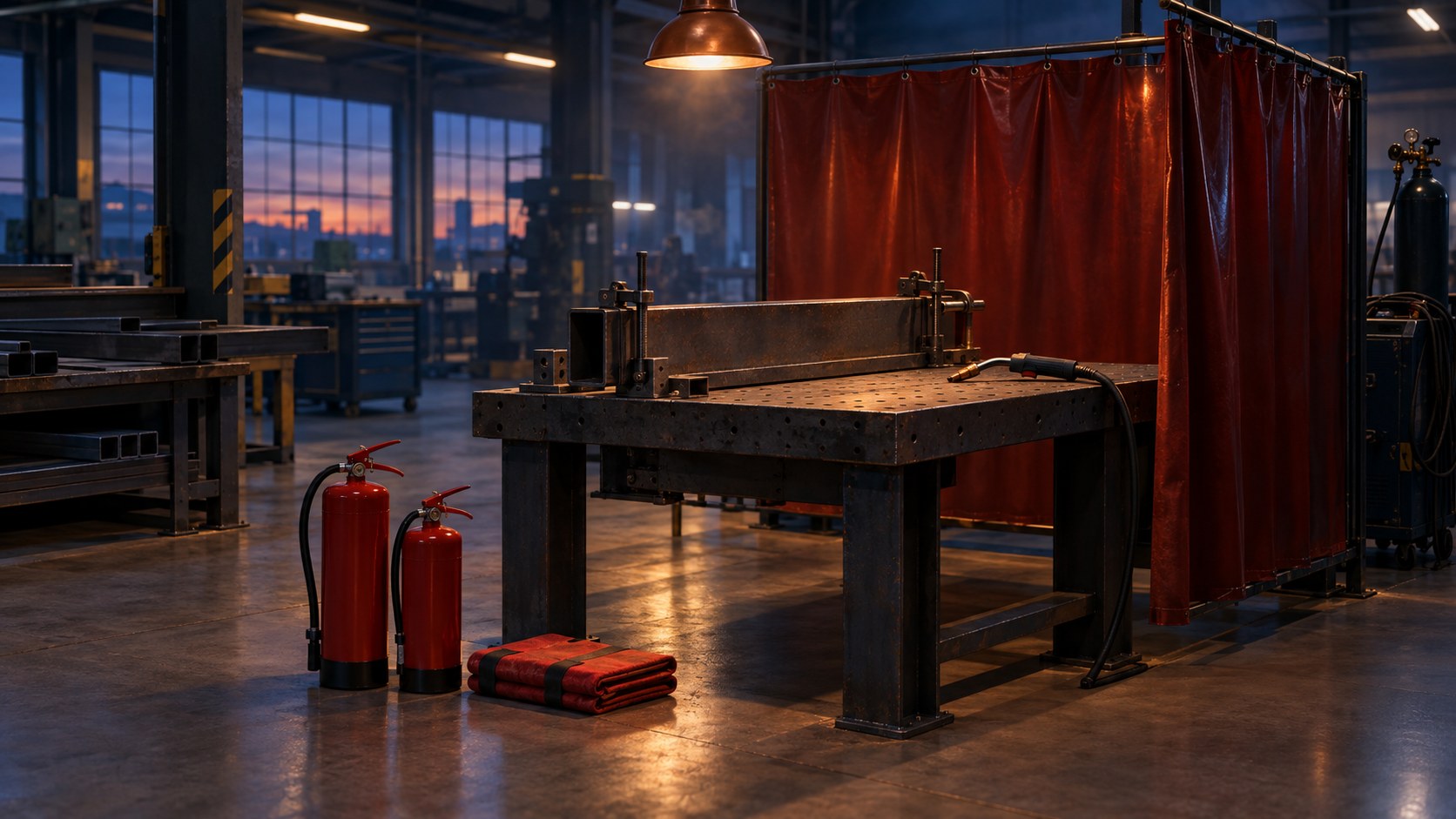
Hot works training teaches people who carry out, supervise or authorise welding, cutting, grinding, brazing, soldering, torch-on roofing and other heat-producing work how to stop that work starting a fire: how to plan it, how a hot work permit works, how to prepare the area, how to keep a fire watch, and what to do if something ignites. No UK law names a specific hot works course or certificate. What the law does require is that employers assess fire risks, use safe systems of work, and give staff adequate training for the risks they face, and hot work is one of the most common ignition sources on construction and refurbishment sites. HSE's guidance is clear that hot work should be avoided where possible and, where it cannot be, tightly controlled with a permit, a cleared area, extinguishers to hand and a fire watch that continues long after the work stops. This guide explains what counts as hot work, what the law and current HSE guidance actually require, the training options that exist, and where the learndirect fire safety courses fit.
If you need general workplace fire training rather than hot work specifically, read our companion guides on fire safety awareness training and fire warden training.
What counts as hot work?
HSE's construction fire guidance, Fire safety in construction (HSG168), defines hot work as any process that generates flame, sparks or heat. The insurance industry's Joint Code of Practice on fire prevention on construction sites uses a similar definition: operations requiring open flames, grinding, welding, the local application of heat or the generation of sparks.
That covers far more than welding. Common examples include:
- Arc, MIG, TIG and gas welding
- Oxy-fuel and plasma cutting
- Grinding and cutting with angle grinders or disc cutters
- Brazing and soldering, including plumbers' blowtorches
- Torch-on roofing and other work with bitumen or gas torches
- Hot air guns, paint stripping with heat, and portable gas heaters
The opposite is cold work: methods that do not create an ignition source, such as push-fit or press-fit pipe joints instead of soldered ones, mechanical cutting instead of flame cutting, or cold-applied roofing systems. HSG168 says hot work should be designed out where reasonably practicable and replaced with cold methods, especially where combustible materials are present.
Why hot work needs controlling
Hot work fires are rarely small. In August 2016 a fire destroyed the main building of Selsey Academy in West Sussex during roof repairs, a GBP 20 million loss that left 450 pupils in temporary classrooms. As RICS reported, hot work was the suspected cause. The same article notes that Zurich saw the cost of damage claims from hot work rise to more than GBP 250 million between 2016 and 2018.
Zurich's own review of three multi-million pound hot work losses, all at schools, shows how these fires happen:
- A gas torch set light to a plastic tarpaulin. There was no hot work permit, materials were stored on the roof, and there was no extinguisher on site. The contractor's insurer refused to cover the loss because the missing extinguisher appeared to breach the policy's hot work conditions.
- During torch-applied roofing, the fire took hold after work had finished for the day. The contractor is believed to have left before the one-hour fire watch was over.
- A permit was in place, but it was a generic permit for a wider programme of work. It was kept in the contractor's cabin and seen only by the person who issued it.
The lesson is that hot work fires are usually a failure of planning and supervision, not bad luck. Training matters because every person in the chain needs to understand why each control is there.
What the law requires
There is no single "hot works regulation". Several overlapping duties apply:
- Health and Safety at Work etc. Act 1974. Employers must provide safe systems of work, information, instruction, training and supervision.
- Management of Health and Safety at Work Regulations 1999. Employers must assess risks, and under regulation 13 provide adequate health and safety training on recruitment and when people are exposed to new or increased risks, repeated periodically where appropriate.
- Regulatory Reform (Fire Safety) Order 2005. The responsible person must carry out a fire risk assessment under article 9 and give employees adequate fire safety training under article 21. HSE notes that on a construction site the responsible person will usually be the main or principal contractor.
- Construction (Design and Management) Regulations 2015. Regulation 29 requires suitable and sufficient steps to prevent, so far as reasonably practicable, injury from fire or explosion during construction work. Regulation 32 covers fire detection and fire-fighting equipment on site.
- Dangerous Substances and Explosive Atmospheres Regulations 2002 (DSEAR). Where work is carried out in hazardous places or involves hazardous activities, Schedule 1 calls for written instructions and a system of permits to work, issued by a person with responsibility for this before the work starts.
- Confined Spaces Regulations 1997. Hot work inside tanks, vessels, ducts or other confined spaces needs a confined space risk assessment, a safe system of work and emergency rescue arrangements.
Put together, the law expects anyone who carries out or controls hot work to be competent to do it safely. It does not prescribe a particular course, so be wary of any provider that says its certificate is "required by law" or "approved by HSE".
How a hot work permit works
A hot work permit is a written authorisation for one specific job, in one specific place, for a limited time. It confirms that the hazards have been checked and the precautions are in place before anyone strikes an arc or lights a torch. The Joint Code of Practice says that all hot work must be covered by a permit once fitting out has started on a construction site, and in all buildings being refurbished.
Under the Joint Code, a good permit system means:
- Each permit covers specific, identified activities and locations, and is signed off at the end of each work period.
- Permits are not issued for long periods. "Blanket" permits covering several days must not be allowed.
- The permit is issued by a nominated person, such as a company safety officer, and accepted by the person doing the work.
- The permit records the precautions, the fire watch and the time of the final check.
- Completed permits are kept and checked regularly by senior project staff.
A permit and a method statement do different jobs. The method statement describes how the work will be done safely. The permit confirms that, at this moment, this area is ready for hot work and named people are responsible for it.
Before, during and after hot work
Before the work starts
- Ask whether a cold method could be used instead.
- Where routine hot work is needed, use a designated area away from combustible material, as HSG168 recommends.
- Clear combustible materials and flammable liquids. The Joint Code's permit checklist covers at least 10 metres around the work, including floors, openings, gaps and the far side of walls or partitions where heat can be conducted.
- Protect anything that cannot be moved with non-combustible boards, blankets or screens.
- Check what is behind or inside panels and cavities. Insulated panels, timber frames and voids can hide a smouldering fire.
- Provide at least two suitable fire extinguishers within reach of the work and the fire watch position (HSG168), and make sure the people there know how to use them.
- Confirm that the area is free of flammable vapours or dust, and that enclosed equipment has been emptied and tested where necessary.
During the work
- Keep a dedicated, trained fire watch throughout the work and during breaks.
- Watch not only the work area but also places sparks or heat could reach, such as the floor below, the other side of a wall or inside a void.
- Stop work if conditions change, for example if combustible materials are brought back into the area.
After the work finishes
Most hot work fires start after the work has stopped, when smouldering material in a void or under a membrane takes hold. Current HSE guidance is stricter than many older training materials:
- HSG168 calls for a continuous fire watch for at least one hour after hot work ends, followed by at least one more check two hours after it ends.
- HSG168 also says hot work should be completed two hours before the end of the working day, so the watch and the final check happen while people are still on site. CITB's hot work guidance gives a minimum of one hour, or two hours for high-risk work such as on or around timber frames.
- Thermal imaging cameras are increasingly used to check for hidden heat, and time-stamped images provide evidence that the fire watch was completed.
- The permit is only closed once the final check has been made and recorded.
If you see "30 minutes" quoted as the fire watch period, it is out of date for UK construction work. Follow HSG168, the Joint Code and any stricter conditions in your insurance policy.
Who needs hot works training?
- Operatives who weld, cut, grind, braze, solder or use torches.
- Fire watchers, who need to know what to look for, where to look, how long to stay and how to use the extinguishers provided.
- Permit issuers and supervisors, who decide whether hot work is justified and check the precautions before signing.
- Site and project managers, who are responsible for the permit system and for checking it is followed.
- Facilities and estates managers in schools, offices, care homes and other occupied buildings who bring in contractors. Two of the three Zurich cases involved a permit that nobody on the client side had seen.
What kind of training is recognised?
Hot work competence is usually built from three layers:
- General fire safety knowledge: how fires start and spread, fire classes, choosing and using extinguishers, raising the alarm and evacuation. Every fire watcher needs this.
- Hot work specific training on permits, preparation, fire watch and post-work checks. On construction and refurbishment sites, many principal contractors and insurers look for the Fire Protection Association's Hot Work Passport. According to CITB, it is aimed at people who carry out, supervise or manage hot work and is valid for five years. Some trades have their own schemes, such as the roofing industry's Safe2Torch.
- Site-specific instruction on the permit system, fire plan and emergency arrangements for that particular site.
Always check your client's site rules and your insurance policy. Many policies include hot work conditions, and breaching them can leave a contractor uninsured for the loss.
How learndirect courses fit
learndirect does not currently offer a dedicated hot works or hot work permit course, and our courses are not a substitute for the FPA Hot Work Passport where a site or insurer requires it. Our CPD-accredited courses do cover the underlying knowledge that fire watchers, operatives and managers need:
- Fire Safety Training (around 60 minutes): how fire starts, spreads and behaves, fire classes and extinguisher types, fire prevention, emergency procedures, and duties under the Fire Safety Order. This is a strong foundation for anyone acting as a fire watch.
- Fire Warden Training (around 1.5 hours): for people with a nominated fire safety role, covering prevention checks, fire drills and evacuation.
- Abrasive Wheel Safety Training (self-paced): for anyone using grinders and cut-off saws, one of the most common sources of hot work sparks.
- Gas Cylinder Transport Training (around 60 minutes): for people who carry propane, acetylene or oxygen cylinders to and from sites.
Each course costs GBP 25 per learner with an instant certificate. For teams, 10 learners cost GBP 212.50, 25 learners GBP 468.75, 50 learners GBP 812.50 and 100 learners GBP 1,375.
Common hot work mistakes
- Using hot work when a cold method would do. The safest hot work is the hot work you never do.
- Generic or blanket permits covering a whole programme of work or several days.
- Permits nobody checks. If the client or site manager never sees the permit, it is paperwork, not a control.
- Leaving combustibles in place, including materials stored on roofs, under membranes or on the far side of a partition.
- No extinguisher to hand, or nobody trained to use one.
- Cutting the fire watch short, or starting hot work so late that the watch would run past the end of the day.
Common questions
Is hot works training a legal requirement?
No law names a specific hot works course. However, employers must assess fire risks, use safe systems of work, and give staff adequate training for the risks they face, including fire safety training under the Fire Safety Order. Where people carry out or control hot work, training on the specific risks and precautions is how employers meet those duties in practice.
What is the difference between a hot work permit and a method statement?
A method statement describes how a task will be done safely. A hot work permit authorises a specific piece of hot work in a specific place for a limited time, confirms the precautions are in place, and names who is responsible. Most sites need both.
How long should a fire watch last after hot work?
For construction work, HSE's HSG168 calls for a continuous fire watch for at least one hour after hot work ends, plus at least one more check two hours after it ends. It also says hot work should be completed two hours before the end of the working day. Your site rules or insurance policy may set longer periods.
What is a Hot Work Passport?
It is a training scheme run by the Fire Protection Association for people who carry out, supervise or manage hot work, and it is widely recognised on construction and refurbishment sites. CITB describes it as valid for five years. Check whether your client or insurer requires it before you start work.
Can a learndirect course replace a Hot Work Passport?
No. Our CPD-accredited fire safety courses build the underlying knowledge of fire behaviour, prevention, extinguishers and emergency procedures, but they are not a hot work permit qualification. If a site or insurer asks for the Hot Work Passport, you will need that specific scheme.
Can hot work be carried out in a confined space?
Only if it cannot be avoided, and only under a confined space safe system of work. That includes atmospheric testing, ventilation, a permit, continuous supervision and rescue arrangements, as required by the Confined Spaces Regulations 1997. Fires and fumes in confined spaces can be fatal very quickly.
What should I do if a fire starts during hot work?
Stop work, raise the alarm and shut off the gas supply if it is safe to do so. Only tackle a fire with an extinguisher if it is small, you are trained, and you have a clear escape route behind you. Otherwise evacuate, call 999 and follow the site fire plan. Do not go back in until the fire service says it is safe.
Get your team trained
Hot work is only as safe as the people planning, doing and watching it. Build the fire safety foundation with CPD-accredited learndirect Fire Safety Training, add Abrasive Wheel Safety Training for anyone using grinders, and check whether your site or insurer requires the FPA Hot Work Passport for permit-controlled work. Each learndirect course costs GBP 25 per learner, with an instant certificate recognised by UK employers. Explore the full range in the learndirect fire safety category.
Frequently asked
Is hot works training a legal requirement?
No law names a specific hot works course. However, employers must assess fire risks, use safe systems of work, and give staff adequate training for the risks they face, including fire safety training under the Fire Safety Order. Where people carry out or control hot work, training on the specific risks and precautions is how employers meet those duties in practice.
What is the difference between a hot work permit and a method statement?
A method statement describes how a task will be done safely. A hot work permit authorises a specific piece of hot work in a specific place for a limited time, confirms the precautions are in place, and names who is responsible. Most sites need both.
How long should a fire watch last after hot work?
For construction work, HSE's HSG168 calls for a continuous fire watch for at least one hour after hot work ends, plus at least one more check two hours after it ends. It also says hot work should be completed two hours before the end of the working day. Your site rules or insurance policy may set longer periods.
What is a Hot Work Passport?
It is a training scheme run by the Fire Protection Association for people who carry out, supervise or manage hot work, and it is widely recognised on construction and refurbishment sites. CITB describes it as valid for five years. Check whether your client or insurer requires it before you start work.
Can a learndirect course replace a Hot Work Passport?
No. Our CPD-accredited fire safety courses build the underlying knowledge of fire behaviour, prevention, extinguishers and emergency procedures, but they are not a hot work permit qualification. If a site or insurer asks for the Hot Work Passport, you will need that specific scheme.
Can hot work be carried out in a confined space?
Only if it cannot be avoided, and only under a confined space safe system of work. That includes atmospheric testing, ventilation, a permit, continuous supervision and rescue arrangements, as required by the Confined Spaces Regulations 1997.
What should I do if a fire starts during hot work?
Stop work, raise the alarm and shut off the gas supply if it is safe to do so. Only tackle a fire with an extinguisher if it is small, you are trained, and you have a clear escape route behind you. Otherwise evacuate, call 999 and follow the site fire plan.
Sources and further reading
- Fire safety in construction, HSG168 (HSE)
- Fire Prevention on Construction Sites: Joint Code of Practice, 10th edition
- Managing hot work (CITB)
- Management of Health and Safety at Work Regulations 1999, regulation 13 (legislation.gov.uk)
- Regulatory Reform (Fire Safety) Order 2005, article 9 (legislation.gov.uk)
- Regulatory Reform (Fire Safety) Order 2005, article 21 (legislation.gov.uk)
- CDM Regulations 2015, regulation 29 (legislation.gov.uk)
- CDM Regulations 2015, regulation 32 (legislation.gov.uk)
- DSEAR 2002, Schedule 1 (legislation.gov.uk)
- How hot work causes fires (RICS)
- Hot works fires: three multi-million pound losses (Zurich)