Asbestos is the single largest cause of work-related deaths in Great Britain. The Health and Safety Executive attributes over 5,000 deaths every year to past occupational exposure - 2,268 mesothelioma deaths (2021), around 2,500 asbestos-related lung cancer deaths, and 537 asbestosis deaths. The victims today are people who breathed in fibres decades ago. The people breathing in fibres now will be tomorrow's statistics unless they are trained to recognise the material and stop before they disturb it.
Asbestos awareness training is not optional. Under Regulation 10 of the Control of Asbestos Regulations 2012, every employer must give adequate information, instruction and training to any employee who is, or is liable to be, exposed to asbestos. That covers the vast majority of tradespeople and maintenance staff working on Great Britain's pre-2000 building stock.
What the regulations actually require
The Control of Asbestos Regulations 2012 (CAR 2012) sit alongside the Health and Safety at Work etc. Act 1974. Two duties matter for anyone working on older buildings:
- Regulation 4 - the duty to manage asbestos in non-domestic premises. The person with responsibility for maintenance and repair must find out whether asbestos is present, presume it is unless proven otherwise, assess the risk, keep a written asbestos management plan and register, and share it with anyone liable to disturb it.
- Regulation 10 - information, instruction and training. Employers must ensure trained workers understand the properties of asbestos, its effects on health (including interaction with smoking), the types of products likely to contain it, the operations that could cause exposure, safe work practices and control measures, the choice and limits of respiratory protective equipment, emergency and decontamination procedures, waste handling, medical examination requirements, and the control limit. Training must be given at regular intervals and refreshed when work methods change.
Regulation 10 also splits training into three levels: asbestos awareness (for anyone who might disturb asbestos - the level this article and course cover), non-licensed work (for lower-risk work with asbestos-containing materials, such as cutting cement sheet), and licensed work (for higher-risk removal, carried out only by HSE-licensed contractors). Asbestos awareness on its own does not authorise anyone to work on asbestos - it teaches you to identify it and stop.
How much asbestos is still in place
Estimates vary by scope. HSE's own working figure, cited in evidence to the Commons Work and Pensions Committee in 2022, is that around 300,000 non-domestic buildings in Great Britain still contain asbestos, within a range of 210,000 to 410,000. Broader estimates that include homes and communal residential premises range up to 1.5 million buildings containing an estimated 6 million tonnes of asbestos.
Any building constructed or refurbished before 2000 could contain asbestos. White asbestos (chrysotile) was only fully banned in the UK in November 1999. Blue and brown asbestos (crocidolite and amosite) were banned in 1985. That means a large share of schools, hospitals, offices, warehouses, social housing and industrial premises still in daily use contains material that becomes lethal the moment someone drills, cuts, sands, breaks or scrapes it.
Where asbestos hides
Asbestos was used because it was cheap, strong, fire-resistant and a good insulator. The result is that it is spread across dozens of common building products. In a typical pre-2000 building you may find asbestos in:
- Sprayed coatings on steelwork and ceilings
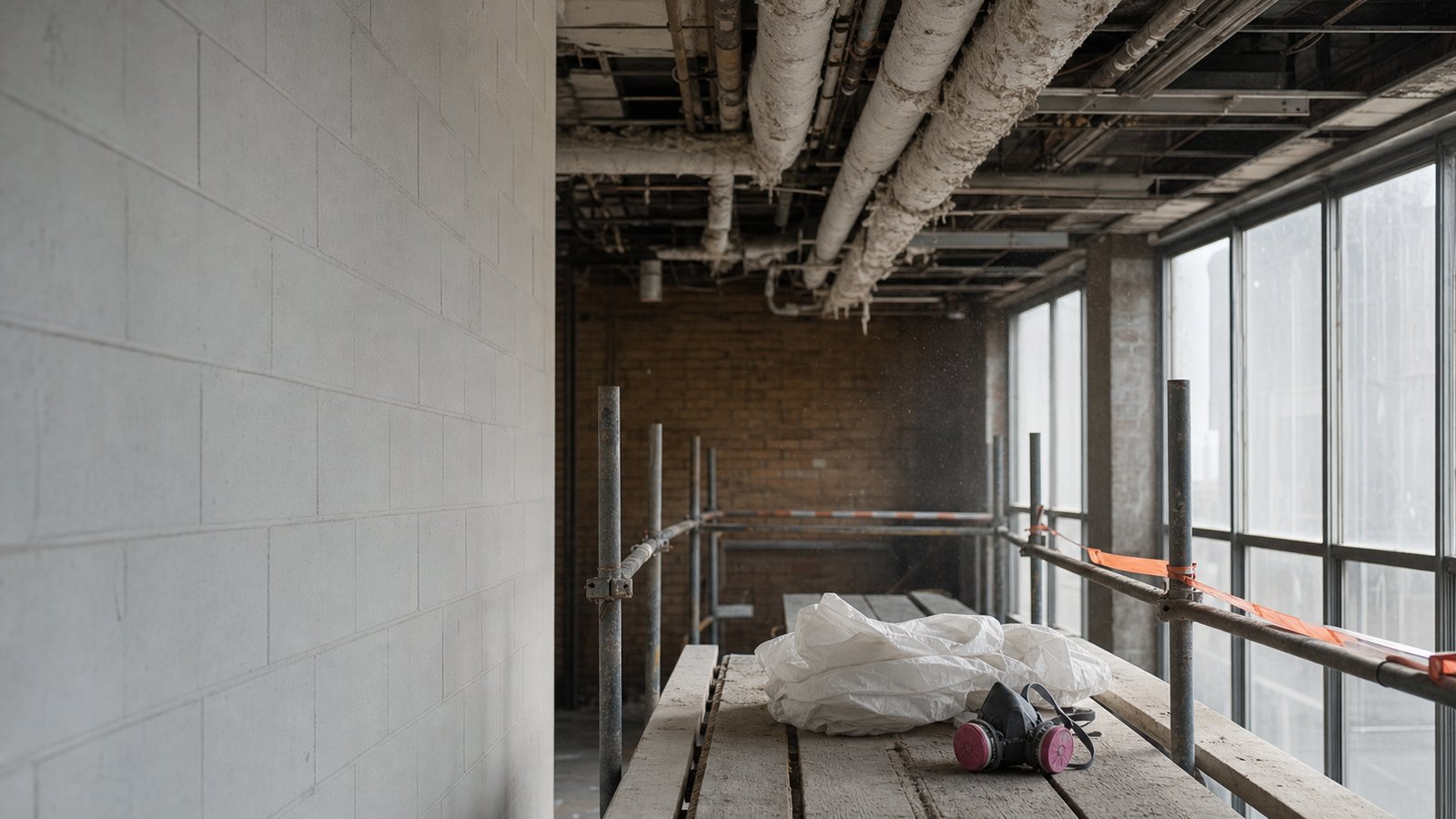
- Pipe and boiler lagging
- Asbestos insulating board (AIB) in ceiling tiles, partition walls, fire doors, service risers, soffits
- Asbestos cement products: corrugated roofing sheets, guttering, downpipes, water tanks, flue pipes
- Textured coatings (Artex-style ceiling and wall finishes applied before 1985)
- Floor tiles and the bitumen adhesive underneath
- Gaskets and rope seals around pipework, boilers, and hatches
- Electrical fuseboards and switchgear insulation
The critical distinction is between friable materials (soft, crumbly, easy to release fibres - sprayed coatings, lagging, AIB) and non-friable materials (harder, bonded matrix - cement sheet, floor tiles). Friable asbestos is the most dangerous and normally requires a licensed contractor. Non-friable asbestos can, under strict conditions, be handled as non-licensed work by trained operatives. Awareness-level training teaches you to spot both and to leave both alone until the register and management plan tell you otherwise.
The three diseases
Fibres inhaled today can cause disease decades later. HSE's latest annual statistics report the following:
- Mesothelioma - an aggressive cancer of the lining of the lung or abdomen caused almost exclusively by asbestos. 2,268 deaths in Great Britain in 2021. Median survival from diagnosis is around 12 months.
- Asbestos-related lung cancer - HSE estimates a similar number of cases as mesothelioma each year, around 2,500 deaths. Risk multiplies for smokers.
- Asbestosis - progressive scarring of the lung tissue causing breathlessness and eventual respiratory failure. 537 deaths in 2021 where asbestosis was recorded on the death certificate without mesothelioma.
There is no known safe level of exposure. Latency from first exposure to symptoms is typically 20 to 50 years. That is why the workers dying today were exposed in the 1970s and 1980s, and why the tradespeople disturbing asbestos today will not know the cost until the 2040s and 2050s.
Who needs asbestos awareness training
HSE's guidance is clear: asbestos awareness training is required for anyone whose work could foreseeably disturb the fabric of a building that may contain asbestos. In practice that covers:
- General maintenance staff and caretakers
- Electricians, plumbers, gas fitters and heating engineers
- Carpenters, joiners and shopfitters
- Painters and decorators
- Plasterers and dry-liners
- Roofers and roofing contractors
- Demolition workers and refurbishment contractors
- Telecoms, alarm, CCTV and cabling installers
- Surveyors, architects and building control officers who conduct intrusive inspections
- Facilities managers and site supervisors responsible for authorising work
Anyone who directly handles asbestos-containing materials needs the higher levels of training (non-licensed or licensed) on top of awareness. Awareness is the baseline. Nobody in the list above should be inducted onto a pre-2000 site without it.
The four rules of asbestos awareness
Formal awareness training runs through the eleven topics named in Regulation 10, but on site the reasoning collapses to four decisions:
- Assume asbestos is present in any pre-2000 building until the register says otherwise. Never rely on how the material looks. AIB, cement sheet and modern non-asbestos board can be indistinguishable to the eye.
- Check the asbestos register and refurbishment/demolition survey before you start. The dutyholder under Regulation 4 is required to keep one. If there is no register, or no survey covering your work area, stop and raise it with the site manager.
- If it is not on the register and might contain asbestos, do not disturb it. Do not drill, sand, saw, scrape, break, snap or dry-sweep. Do not power-wash it. Do not use compressed air on it. Isolate the area and get a survey.
- If you have already disturbed suspected asbestos, stop, contain and report. Do not carry on. Do not send anyone in to clean up. Restrict access, keep your PPE on, decontaminate under supervision, and record the incident. Suspected uncontrolled releases must be reported to HSE under RIDDOR.
Where the learndirect online course fits
The learndirect Asbestos Awareness course is a Category A awareness course - the foundation level named in HSE guidance and Regulation 10. It takes about 60 minutes, delivers 1 CPD hour, is CPD-accredited, costs £25 + VAT per learner, and issues an instant downloadable certificate on completion. Volume discounts apply for teams.
- What it is: the online, self-paced awareness module that satisfies the training duty under Regulation 10 for workers who need to recognise and avoid asbestos. It is suitable for maintenance staff, tradespeople, site supervisors, facilities managers, and anyone else being inducted onto a pre-2000 site.
- What it is not: it is not Category B (non-licensed work) or Category C (licensed removal) training. It does not authorise anyone to work on, cut, drill or remove asbestos-containing materials. Non-licensed and licensed work require face-to-face practical training from HSE-approved providers.
- Refresher cadence: HSE guidance recommends refresher awareness training annually, or sooner when work methods, materials, or roles change. The learndirect course can be retaken each year.
Practical steps for employers
If you employ people who might disturb the fabric of a building built before 2000, you have three concrete duties this quarter:
- Confirm you have an up-to-date asbestos survey and register for every non-domestic premises where you or your contractors work. If a refurbishment or demolition survey is missing before intrusive work, commission one.
- Get every worker in a foreseeable-exposure role trained to awareness level and refresh them annually. Keep training records for at least five years.
- Include asbestos in site inductions and permit-to-work systems. No worker on a pre-2000 site should be permitted to break, drill or cut any material until the register has been checked and cleared.
Cost is not a reasonable objection. Training a team of fifty workers on the learndirect Asbestos Awareness course at £25 + VAT per learner is £1,250 - less than a single day's legal costs on the wrong side of an HSE prosecution, and immeasurably less than the personal cost of a mesothelioma diagnosis to the worker and their family. The regulation is clear, the risk is documented, and the training is a one-hour investment. There is no defensible reason for a pre-2000 workforce to be untrained.
Frequently asked
Is asbestos awareness training a legal requirement?
Yes, where employees are or are liable to be exposed to asbestos. Regulation 10 of the Control of Asbestos Regulations 2012 requires employers to ensure adequate information, instruction and training for such employees. In practice, HSE guidance treats awareness training as the induction-level requirement for any worker whose duties could foreseeably disturb the fabric of a building constructed before 2000. That includes maintenance staff, tradespeople, site supervisors, surveyors and facilities managers.
What is the difference between asbestos awareness and licensed asbestos training?
Regulation 10 recognises three tiers. Asbestos awareness (Category A) teaches workers to recognise and avoid asbestos-containing materials; it does not authorise anyone to work on them. Non-licensed work training (Category B) covers lower-risk work with certain non-friable asbestos-containing materials, such as cutting cement sheet, under specified conditions. Licensed work training (Category C) is required for higher-risk work with more friable asbestos-containing materials such as sprayed coatings, lagging and insulation board, and is carried out only by HSE-licensed contractors. Awareness is the baseline; the other tiers require additional practical, face-to-face training.
How often does asbestos awareness training need to be refreshed?
HSE guidance recommends refresher awareness training annually, or sooner if there is a significant change in the type of work, the materials being handled, the control measures in use, or the employee's role. Regulation 10(2)(a) requires training to be given at regular intervals, and 10(2)(b) requires it to be adapted to take account of any significant changes. Keeping training records for at least five years is standard practice and is what HSE inspectors expect to see on an audit.
How many buildings in the UK still contain asbestos?
Estimates vary depending on what is being counted. HSE's own working figure, cited in evidence to the Commons Work and Pensions Committee in 2022, is that around 300,000 non-domestic buildings in Great Britain still contain asbestos, within a range of 210,000 to 410,000. Broader estimates that include homes and communal residential premises range up to 1.5 million buildings containing an estimated 6 million tonnes of asbestos. Any building constructed or refurbished before 2000 could contain asbestos-containing materials.
Who is responsible for managing asbestos in a workplace?
Under Regulation 4 of CAR 2012, the duty to manage asbestos in non-domestic premises falls on the person who has, by virtue of a contract or tenancy, an obligation to any extent for the maintenance or repair of the premises. That is often the employer, landlord, facilities manager, or building owner. The duty-holder must find out whether asbestos is present, presume it is if there is doubt, record its location and condition, assess the risk, prepare an asbestos management plan, and make the information available to anyone liable to disturb the material - including contractors and their workers.
What should I do if I think I have disturbed asbestos?
Stop work immediately. Do not attempt to clean up. Keep everyone else out of the area and do not sweep, vacuum or hose the surface. Where practicable, isolate the area, close doors, switch off any ventilation that could spread fibres, and keep your PPE on until you can be decontaminated under supervision. Report the incident to your site manager or duty-holder without delay. Where fibres are likely to have been released uncontrolled into a workplace, the duty-holder must report the incident to HSE under RIDDOR. Arrange decontamination and, where recommended, a medical review.
How much does the learndirect Asbestos Awareness course cost?
The learndirect Asbestos Awareness Training course is £25 per learner plus VAT for the online CPD-accredited awareness element. It takes about 60 minutes and awards 1 CPD hour with an instant downloadable certificate on completion. Bulk pricing and a multi-user admin portal are available for employers rolling out workforce-wide awareness training across pre-2000 sites.
Sources and further reading
- HSE: Asbestos-related disease statistics 2023
- HSE: Asbestos (topic hub)
- HSE: Asbestos training
- HSE INDG223: A short guide to managing asbestos in premises
- Control of Asbestos Regulations 2012 (legislation.gov.uk)
- Control of Asbestos Regulations 2012, Regulation 10 - Information, instruction and training
- Health and Safety at Work etc. Act 1974
- House of Commons Work and Pensions Committee: The Health and Safety Executive's approach to asbestos management (2022)
- learndirect Asbestos Awareness Training