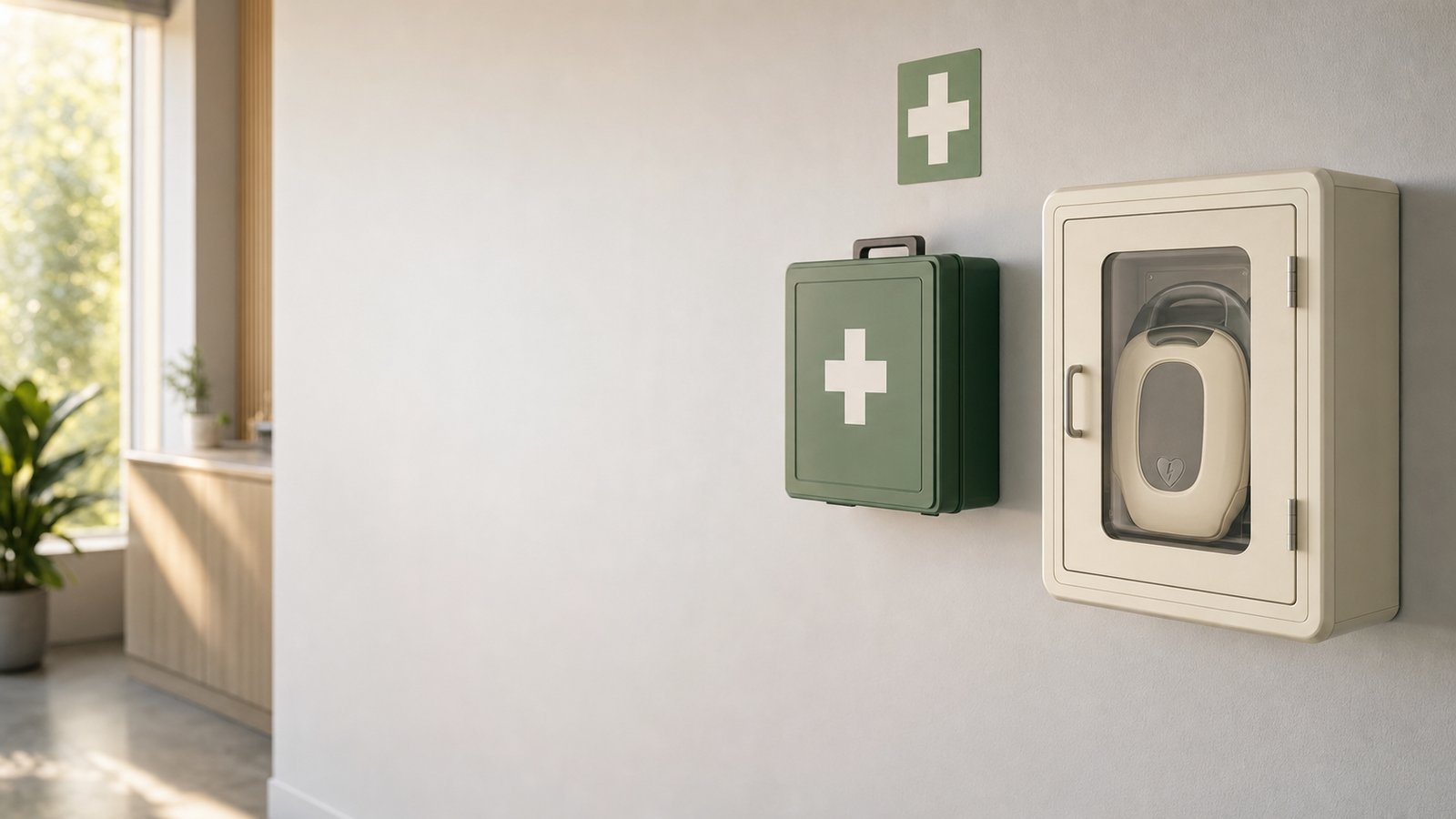
First aid at work is the framework the Health and Safety Executive (HSE) uses for how UK employers plan for injuries and illness in the workplace. It is built around the Health and Safety (First-Aid) Regulations 1981, which require every employer to provide "adequate and appropriate" first-aid equipment, facilities and personnel. In practice, that translates into two nationally recognised qualifications, First Aid at Work (FAW) and Emergency First Aid at Work (EFAW), sitting on top of a workplace first-aid needs assessment. This guide explains what the law actually says, how the two qualifications differ, and where the learndirect online course fits.
What the Regulations actually require
The Health and Safety (First-Aid) Regulations 1981 apply to all workplaces, from single-person self-employed workers to large multi-site employers. The regulations require you to provide "adequate and appropriate" first-aid equipment, facilities and people so that employees can be given immediate help if they are injured or taken ill at work.
HSE guidance in INDG214 "First aid at work: your questions answered" sets the minimum provision on any work site as three things:
- a suitably stocked first-aid kit;
- an appointed person to take charge of first-aid arrangements;
- information for employees about first-aid arrangements.
An "appointed person" is not the same as a first aider. HSE describes an appointed person as someone who looks after first-aid equipment and facilities, calls the emergency services when required, and provides cover when a first aider is unexpectedly absent. They do not need any first-aid training. An appointed person is not needed where there are enough appropriately trained first aiders on site.
First Aid at Work (FAW) vs Emergency First Aid at Work (EFAW)
Once your first-aid needs assessment identifies that a trained first aider is required, HSE recognises two main qualifications:
- Emergency First Aid at Work (EFAW): a shorter qualification that enables a first aider to give emergency first aid to someone who is injured or becomes ill while at work. Typically delivered as a one-day classroom course covering the priorities of first aid (primary survey, CPR, unconscious casualty, choking, severe bleeding, shock).
- First Aid at Work (FAW): the fuller qualification. It includes everything EFAW covers, and adds specific injuries and illnesses (fractures, sprains, head and spinal injury, burns, poisoning, eye injuries, chest pain, stroke, seizures, asthma, anaphylaxis, diabetic emergencies). Typically delivered as a three-day (around 18-hour) classroom course.
Both are practical, competence-based qualifications assessed in a classroom setting by a training provider. Since 1 October 2013, HSE has no longer approved specific first-aid training providers; instead, employers are expected to carry out their own due diligence when selecting a provider (see HSE's information sheet GEIS3). Nationally regulated qualifications, the voluntary aid societies (St John Ambulance, British Red Cross, St Andrew's First Aid) and providers operating under voluntary accreditation schemes are all acceptable, provided they meet HSE's due-diligence criteria.
When Emergency First Aid at Work (EFAW) is enough
Employers often ask whether they need the three-day FAW course or whether the shorter Emergency First Aid at Work qualification is sufficient. The honest answer is that the needs assessment decides, not the course brochure. HSE's own steer in INDG214 is that EFAW is likely to be enough in low-hazard workplaces with a small, stable workforce and easy access to emergency services. Typical examples HSE gives include small shops, offices, libraries and similar settings.
An Emergency First Aid at Work first aider is trained to keep a casualty alive and stable until the ambulance arrives. The syllabus is focused on time-critical priorities:
- the primary survey and safe approach to the incident;
- an unresponsive, breathing casualty (recovery position, monitoring);
- an unresponsive, non-breathing casualty (CPR and safe use of an AED);
- choking (mild and severe);
- severe external bleeding (direct pressure, dressings, catastrophic bleed control where taught);
- shock (physiological, not just emotional);
- minor injuries (small cuts, grazes, minor burns and scalds, splinters).
What EFAW deliberately does not cover, and where you need FAW, is the wider syllabus of specific injuries and medical conditions: fractures and dislocations, head and spinal injury, more extensive burns, poisoning, eye injuries, chest pain, stroke, seizures, asthma, anaphylaxis and diabetic emergencies. If your workforce is more likely to encounter any of those, or your workplace is remote from emergency services, the needs assessment should push you to FAW.
Cardiac arrest is a useful example of why the EFAW skill set matters even in a low-hazard office. NHS ambulance services in England attempt resuscitation on around 30,000 out-of-hospital cardiac arrests each year, and around 15% of those happen in a workplace (roughly 72% happen at home) according to Resuscitation Council UK epidemiology data. Survival to hospital discharge across all UK OHCAs sits below one in ten, but where a bystander performs CPR and a public-access defibrillator is used before the ambulance arrives, published UK ambulance-service data shows survival can be over five times higher. That is exactly the four-to-eight-minute window an EFAW first aider is trained to bridge.
Two practical rules of thumb HSE inspectors tend to apply:
- If your workplace already needs a designated first aider under the needs assessment, defaulting to EFAW is only defensible if the assessment explicitly justifies why the wider FAW syllabus is not required.
- Wherever an AED is installed, at least one first aider on site during working hours should be trained in its use. EFAW covers AED use as standard, so an EFAW first aider is a sensible minimum for any site with a public-access defibrillator.
EFAW is a genuine qualification, not a cut-price FAW. It is delivered by the same regulated awarding organisations, assessed practically in a classroom, and is worth the same three-year certificate. It is not a substitute for FAW where the needs assessment calls for the full syllabus, but it is the right choice for many low-hazard employers and it is a much better answer than "an appointed person and hope for the best".
How many first aiders do you need?
There is no headcount rule in UK law. HSE's Table 2 in INDG214 gives a suggested minimum based on hazard level and workforce size, not a legal requirement:
- Low-hazard workplaces (offices, shops, libraries):
- Fewer than 25 employees: at least one appointed person.
- 25 to 50 employees: at least one first aider trained in EFAW.
- More than 50 employees: at least one first aider trained in FAW for every 100 employed (or part thereof).
- Higher-hazard workplaces (light engineering and assembly, food processing, warehousing, construction, chemical manufacture, extensive dangerous machinery):
- Fewer than 5 employees: at least one appointed person.
- 5 to 50 employees: at least one first aider trained in EFAW or FAW, depending on the type of injuries that might occur.
- More than 50 employees: at least one first aider trained in FAW for every 50 employed (or part thereof).
These numbers are guidance only. The regulator's real test is whether provision is "adequate and appropriate" given your risk assessment, working pattern, site layout, remoteness from emergency services, and any special hazards. Shift work, remote workers, multi-building sites and lone workers usually push the number of first aiders higher than Table 2 suggests, because provision must be available at all times people are at work, including annual leave and unplanned absence.
What FAW training covers
A full First Aid at Work qualification covers, at minimum:
- The role of the first aider: priorities of first aid, primary survey, calling for help, infection prevention.
- Assessing an incident: approaching safely, identifying hazards, checking responsiveness, checking airway and breathing.
- Unconscious casualty: maintaining the airway, breathing, placing in the recovery position, monitoring.
- Cardio-pulmonary resuscitation (CPR): chest compressions, rescue breaths, adult and where relevant paediatric technique, safe use of an automated external defibrillator (AED).
- Choking: back blows, abdominal thrusts, escalation.
- Severe bleeding and shock: direct pressure, dressings, tourniquets (where appropriate), recognising physiological shock.
- Fractures, dislocations, sprains and strains: immobilisation, support and preventing further injury.
- Head, neck and spinal injury: minimising movement, recognising concussion.
- Burns and scalds: cooling, dressing, assessing depth.
- Medical emergencies: heart attack, stroke, asthma attack, anaphylaxis, diabetic emergencies, seizures, poisoning.
- Handover to the emergency services: what information to give, record-keeping, casualty support.
Assessment for the regulated qualification is practical, not just written. A candidate is observed performing techniques such as CPR on a manikin, primary survey and recovery position under the eye of a qualified trainer. This is why the full FAW cannot be delivered purely online.
Where the learndirect online course fits
The learndirect First Aid at Work Training course is an online, CPD-certified knowledge course. It is designed to build confidence in the core concepts of workplace first aid, using scenario-based content that walks a learner through casualty assessment, the primary survey, CPR, choking, bleeding, burns, shock and common medical emergencies. It is honest about what it is and what it is not:
- What it is: a knowledge-based introduction and ongoing refresher. Around 60 minutes of study, 1 CPD hour, an instant downloadable CPD certificate on completion, priced at £25 per learner plus VAT. Suitable for whole-workforce awareness roll-outs, induction for new starters, or a knowledge top-up between three-year FAW refreshers.
- What it is not: a substitute for the regulated First Aid at Work qualification. If your first-aid needs assessment identifies that you need a designated first aider trained in FAW or EFAW under HSE guidance, book a classroom-based course with a competent training provider that includes practical assessment. An online course cannot observe a candidate performing CPR on a manikin, and cannot award the regulated FAW qualification on its own.
Used properly, the online course is a strong complement to the regulated qualification. A common pattern is to send designated first aiders on the three-day classroom FAW, and then use the £25 online course as an annual refresher for the wider team so that everyone has a shared vocabulary and knows what to do in the first few minutes of an incident.
Certificate validity and refresher training
The regulated FAW qualification is generally valid for three years from the date of the certificate. HSE strongly recommends annual refresher training for first aiders between full requalification to keep basic skills current, particularly CPR and the use of an AED. Requalification for FAW is typically a two-day classroom course, and for EFAW a one-day course.
Missing the three-year requalification window means the first aider must complete the full FAW or EFAW course again. HSE gives a short grace period of up to one month in some circumstances but this is at the training provider's discretion, not a legal right. Building refresher dates into your compliance calendar avoids the last-minute rush.
What a first-aid needs assessment should cover
HSE's Table 1 in INDG214 sets out the checklist for a proper first-aid needs assessment. In summary, an employer should consider:
- Hazards: the outputs of your general workplace risk assessment, and whether any part of the workplace has higher-hazard activities that need extra provision.
- Employees: total number on site, whether there are inexperienced workers, work-experience placements or employees with disabilities or health conditions.
- Accident and ill-health records: what has actually happened in your workplace and where.
- Working arrangements: shift work, lone workers, remote workers, multi-building sites, working with other employers.
- Non-employees: members of the public, visitors, contractors. There is no legal duty to provide first aid for non-employees, but HSE strongly recommends including them in the assessment.
- Absence cover: how you plan for planned and unplanned absence of first aiders and appointed persons.
The assessment should be documented, reviewed periodically (particularly after any material change to the business), and used as the basis for how many first aiders you appoint and what level of training they need.
Practical steps for employers
- Do the first-aid needs assessment first. Do not start by booking a course. HSE expects the assessment to drive the training decision, not the other way round.
- Vet your training provider. Since October 2013, HSE no longer maintains an approved list. Ask the provider for their trainer qualifications, quality assurance system and evidence of the awarding body's recognition. HSE's GEIS3 information sheet gives the due-diligence checklist.
- Plan for absence. One first aider on site is one holiday away from no first aider. Cover annual leave and sickness in your headcount, not just the minimum.
- Refresh annually, requalify every three years. Book a short annual refresher for CPR and AED, and a full requalification before the three-year certificate expires.
- Use an online awareness course to raise the baseline. Once your designated first aiders are in place, an online course such as the learndirect First Aid at Work Training gives the rest of the workforce a shared foundation and helps them recognise when to fetch a first aider.
- Tell your people who the first aiders are. HSE requires you to inform employees of your first-aid arrangements; a notice with names and locations is usually enough.
Frequently asked
When is Emergency First Aid at Work (EFAW) enough, and when do I need First Aid at Work (FAW)?
HSE's steer in INDG214 is that EFAW is usually enough in low-hazard workplaces (small shops, offices, libraries) with a small stable workforce, good access to emergency services and no unusual medical risk. FAW is expected where the needs assessment identifies higher hazards (light engineering, warehousing, food processing, construction, chemical work, dangerous machinery), remote sites, larger workforces, or a realistic chance of specific medical emergencies such as stroke, anaphylaxis or diabetic collapse. If you already need a designated first aider, defaulting to EFAW is only defensible where the needs assessment explicitly justifies why the wider FAW syllabus is not required.
Is First Aid at Work a legal requirement?
No, there is no legal requirement for every employee to hold a FAW qualification. The legal requirement is on the employer under the Health and Safety (First-Aid) Regulations 1981 to provide adequate and appropriate first-aid equipment, facilities and personnel. Whether that means an appointed person, an EFAW first aider or a FAW first aider is decided by a first-aid needs assessment based on workplace hazards, workforce size, working arrangements and history of injury or illness.
What is the difference between First Aid at Work and Emergency First Aid at Work?
Emergency First Aid at Work (EFAW) is a shorter one-day qualification covering the priorities of first aid: primary survey, CPR, unconscious casualty, choking, severe bleeding and shock. First Aid at Work (FAW) is a fuller three-day (around 18-hour) qualification that includes everything EFAW covers, plus fractures, head and spinal injury, burns, medical emergencies such as stroke and anaphylaxis, and eye injuries. HSE recognises both, and the needs assessment decides which is appropriate for your workplace.
How many first aiders do I need in my workplace?
HSE does not set a legal headcount rule. Table 2 in INDG214 suggests, for a low-hazard workplace, at least one appointed person for fewer than 25 employees, at least one EFAW first aider for 25 to 50 employees, and at least one FAW first aider for every 100 employed (or part thereof) above 50. Higher-hazard workplaces need more provision at every level. These are suggested minimums; your risk assessment and working arrangements may require more, particularly for shift work, lone workers and multi-site operations.
Can I get a First Aid at Work qualification entirely online?
No, not the full HSE-recognised regulated FAW qualification. The regulated qualification is assessed practically in a classroom setting, including observation of CPR on a manikin, primary survey and casualty management. Online courses like the learndirect First Aid at Work Training course are useful for knowledge-based induction, ongoing workforce awareness and refresher use, but they do not replace the classroom-based FAW or EFAW qualifications for designated first aiders.
How long is a First Aid at Work certificate valid for?
The regulated FAW qualification is generally valid for three years from the date of certification. HSE strongly recommends annual refresher training between full requalification, particularly for CPR and the use of an AED. Once the three years are up, first aiders must requalify, which is typically a two-day course for FAW and a one-day course for EFAW.
Do I have to use an HSE-approved training provider?
There is no HSE-approved list anymore. Since 1 October 2013 HSE has not approved specific first-aid training providers. Employers select their own provider and are expected to carry out due diligence, checking the provider's competence, trainer qualifications, course content and quality-assurance systems. HSE's GEIS3 information sheet is the reference checklist. Nationally regulated qualifications, the voluntary aid societies and accredited providers are all acceptable when they meet the due-diligence criteria.
How much does the learndirect First Aid at Work course cost?
The learndirect First Aid at Work Training course is £25 per learner plus VAT for the online CPD-certified knowledge element. It takes around 60 minutes to complete and awards an instant, downloadable CPD certificate. Bulk pricing and a multi-user admin portal are available for employers rolling out workforce-wide awareness training.
Sources and further reading
- HSE INDG214 (rev2): First aid at work - your questions answered
- HSE: The Health and Safety (First-Aid) Regulations 1981 - legislation summary
- HSE GEIS3: Selecting a first-aid training provider
- HSE L74: First aid at work - Guidance on Regulations (Third edition)
- Resuscitation Council UK: Epidemiology of out-of-hospital cardiac arrest in the UK
- Health and Safety (First-Aid) Regulations 1981
- Health and Safety at Work etc. Act 1974
- learndirect First Aid at Work Training course