
Thinking about starting a career in nursing but not sure how long it really takes? For most people, training to become a nurse in the UK takes around three years of full-time study. But that’s just the average. If you already have a degree, work in healthcare, or need to study part-time, your journey could look a little different.
Nursing is a flexible, respected, and rewarding career that welcomes people from all walks of life. Whether you’re returning to education after years away or making a complete career change, this guide explains what to expect, how long it takes, and which route might be right for you.
Ready to start your new career? Explore learndirect’s accredited nursing courses to find the path that fits you best.
How Long Does Nursing Training Take in the UK?
Most full-time nursing degrees in the UK take three years to complete. This includes both classroom learning and clinical placements where you gain hands-on experience. If you already hold a degree in another subject, you can qualify faster through an accelerated two-year postgraduate route.
Some people prefer a slower pace. If you’re balancing work, family, or other responsibilities, many universities and training providers now offer part-time courses that can take four to six years to finish.
Quick summary:
- Standard nursing degree – 3 years full-time
- Accelerated postgraduate route – 2 years
- Nursing Associate to RN pathway – about 4 years total
- Part-time study – 4 to 6 years
| Route | Duration |
Entry Requirements |
Typical Outcome |
|---|---|---|---|
|
BSc Nursing |
3 years full-time |
A-Levels or equivalent |
Registered Nurse (Adult, Child, Mental Health, or Learning Disability) |
|
Accelerated MSc |
2 years |
Prior degree |
Registered Nurse |
|
Nursing Associate Route |
Around 4 years |
Level 3 Apprenticeship |
Registered Nurse |
|
Part-time Degree |
4–6 years |
Flexible entry |
Registered Nurse |
Training length can vary depending on how much time you can commit and whether you already have healthcare experience.
Is a Nursing Degree Required to Become a Nurse in the UK?
Yes, all registered nurses in the UK must complete a degree approved by the NMC. This ensures every nurse meets the same national standards of care and patient safety.
But that doesn’t mean you need traditional academic qualifications. Adults returning to study often start with an Access to Higher Education Diploma in Nursing, which can be finished in 9 to 12 months and qualifies you to apply for university-level study.
Some NHS Trusts also offer nursing apprenticeships, where you earn a salary while studying. These combine academic learning with on-the-job experience, typically over four years.
You can begin your nursing career even without A-levels. Start with an Access to HE Diploma and progress to university.
What Are the Steps to Become a Nurse in the UK?
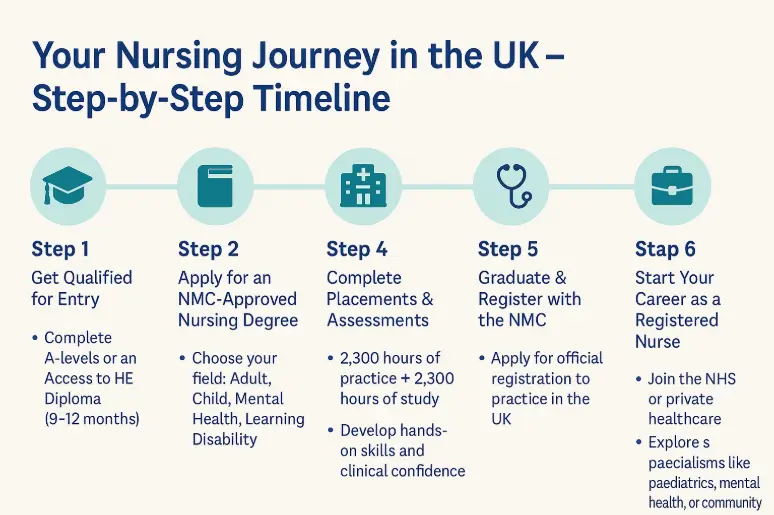
The journey to becoming a nurse involves a few key milestones. Here’s what it looks like in real life:
- Meet the entry requirements. You’ll need A-levels, an Access to HE Diploma, or an equivalent Level 3 qualification.
- Apply for an NMC-approved nursing degree. Choose your specialism: Adult, Child, Mental Health, or Learning Disability.
- Complete your degree and placements. Every student must log over 4,600 combined hours of study and clinical work.
- Register with the NMC. After graduation, you’ll apply for professional registration to legally practice in the UK.
- Start your career as a Registered Nurse. Most new nurses begin in the NHS before branching into community or specialist roles.
Learn more about flexible nursing pathways in the UK.
Can International Students Study Nursing in the UK?
Yes. International students can complete a UK nursing degree in three years and then register with the NMC to work in the UK. Some NHS Trusts also offer sponsorship programs for qualified nurses abroad..
To study in the UK, you’ll need a Student Visa and an IELTS score of at least 7.0 overall, with no section below 6.5. After graduating, you can register with the NMC and begin working in the NHS or private healthcare.
If you’re already a qualified nurse overseas, you can apply for NMC registration via the Overseas Nursing Programme and often begin work after completing a short adaptation or OSCE test.
What Qualifications Do I Need for Nursing School?
Before you apply for a nursing degree, it helps to understand the different entry routes available. The UK has designed several options so that both school leavers and adults returning to education can qualify for nursing school.
If you’ve recently completed your A-levels, you can apply directly to a BSc Nursing degree through UCAS. Those with work or family commitments often choose an Access to Higher Education (HE) Diploma, which acts as a bridge to university-level study and can be completed online in under a year.
If you already work in healthcare, a Level 3 Health and Social Care qualification or a Nursing Associate Apprenticeship can also count toward entry. These routes give you hands-on experience while earning and learning, and later allow you to “top up” to a full nursing degree.
Different routes suit different learners. Here’s how long each path takes and what it involves:
|
Qualification Route |
Typical Entry |
Duration |
|---|---|---|
|
A-Levels (Biology or Chemistry recommended) |
3 subjects |
3 years degree |
|
Access to HE Diploma (Health or Nursing) |
Equivalent to A-Levels |
9–12 months prep + 3 years degree |
|
Level 3 Health & Social Care |
May require extra credits |
3 years degree |
|
Nursing Associate Apprenticeship |
Level 3 Apprenticeship |
2 years + top-up degree (2 years) |
Access to HE courses are the most popular choice for mature students because they’re accepted by most UK universities, can be studied online, and fit around family life.
Start with an Access to HE Diploma to fast-track your entry into nursing school.
Are There Accelerated Nursing Programmes in the UK?
If you already have a degree, you can fast-track your training with an accelerated postgraduate nursing course, usually lasting two years.
These programmes build on your existing academic skills and focus heavily on clinical training. Universities like King’s College London, Southampton, and Birmingham all offer two-year graduate-entry options.
You can also shorten training through Recognition of Prior Learning (RPL) if you’ve already worked in healthcare. Some modules or placement hours may be credited, reducing your total study time.
Fast-track nursing programs are perfect for adults switching careers who already hold a degree, reducing training to just two years.
How Do Clinical Placements Work in Nursing Education?
Clinical placements are the backbone of every nursing course. They give you real-world experience in hospitals, GP surgeries, care homes, and community health services.
Each placement typically lasts 6–12 weeks. You’ll rotate through different departments, learning to manage patient care, administer medications, and work within multidisciplinary teams.
By graduation, you’ll have completed over 2,300 hours of supervised clinical experience, building the confidence and professional judgment needed to handle real patients from day one.
Clinical placements make up about 50% of all nursing programs in the UK, giving students essential real-world experience in patient care.
What Is the Cost of Nursing School in the UK?
Tuition fees for UK nursing degrees are generally the same as other university courses, but the financial support available makes them far more accessible.
|
Course Type |
Average Annual Cost |
Financial Support |
|---|---|---|
|
BSc Nursing |
£9,250 per year |
Student Finance + NHS Learning Support Fund (£5,000 grant) |
|
MSc Nursing (Accelerated) |
£9,250 per year |
Postgraduate Loan + possible NHS or employer sponsorship |
Every eligible nursing student in England can access the NHS Learning Support Fund, which offers:
- A non-repayable £5,000 grant per academic year
- Extra childcare and travel allowances
- A £1,000 specialist payment for high-demand areas like mental health or learning disability nursing
Funding makes nursing one of the most affordable routes into a professional healthcare career.
Is Nursing a Good Career in the UK?
Yes, and for many reasons. Nursing combines emotional fulfilment with job security. You’ll be joining a workforce of over 700,000 registered nurses, with the NHS alone aiming to recruit thousands more each year.
Salaries start at around £28,000 (Band 5) for new graduates and can rise to over £60,000 (Band 8) for advanced or specialist roles. Beyond pay, nurses enjoy career flexibility, international mobility, and the satisfaction of improving lives daily.
Nursing is one of the most secure and rewarding careers in the UK, and it’s always in demand.
Nursing is one of the most secure and rewarding careers in the UK, with over 700,000 registered nurses and growing demand for qualified professionals.
Start your journey toward a meaningful nursing career today.
Can I Study Nursing Part-Time or Online in the UK?
Yes, and it’s a popular option for adults balancing study with work or family life. Many universities and training providers offer blended nursing degrees that combine online theory with local clinical placements.
Alternatively, you can begin with an online Access to HE Diploma, which prepares you for university-level study at your own pace.
These routes may take longer to complete, but they give you the flexibility to progress toward your goal without putting your life on hold.
Explore flexible and online nursing qualifications made for busy adults.
Wrapping All Up
Becoming a nurse in the UK takes time and effort, but the rewards are lifelong. You’ll gain respected qualifications, real clinical skills, and a chance to make a daily difference in people’s lives.
Whether you take the standard three-year degree, a fast-track graduate course, or a part-time path, there’s a route that fits your story.
Start today with learndirect’s nursing courses and take the first step toward a career that truly matters.
FAQ
How many years does it typically take to become a qualified nurse in the UK and what are the main training pathways?
Most people qualify as a nurse in three years through a full-time BSc Nursing degree approved by the NMC. If you already have a degree, the two-year accelerated MSc route lets you qualify faster. You can also train through nursing apprenticeships or flexible part-time programs lasting up to six years.
What is the fastest route to qualify as a nurse in the UK, including any accelerated nursing programs available?
The quickest path is the two-year postgraduate nursing course, designed for graduates in any subject. These programs build on existing academic experience and focus on clinical skills. Some learners also shorten their degree through Recognition of Prior Learning (RPL) if they’ve already worked in healthcare.
What factors affect the time required to become a nurse in the UK, and how can I speed up the process?
Your previous education, study mode, and personal schedule all make a difference. Full-time students finish fastest, while part-time or apprenticeship routes take longer. You can reduce your timeline by choosing an accelerated course, transferring credits through RPL, or starting with an Access to HE Diploma for a quicker university entry.
How do part-time and full-time UK nursing courses compare in terms of required study time for qualification?
Full-time degrees take three years, with about 4,600 total study and placement hours. Part-time courses spread that same training over four to six years, giving you flexibility to balance study with work or family. Both lead to the same NMC registration and recognised nursing qualification.
Where can I get information on nursing course durations and timelines in the UK?
You can find up-to-date information on learndirect’s nursing course pages and compare routes for adults, graduates, and apprenticeships. Official resources like NHS Health Careers and the NMC also list accredited programs, entry requirements, and course timelines across the UK.
Interested in studying nursing? Click below to download our FREE online nursing course brochure for more information!